











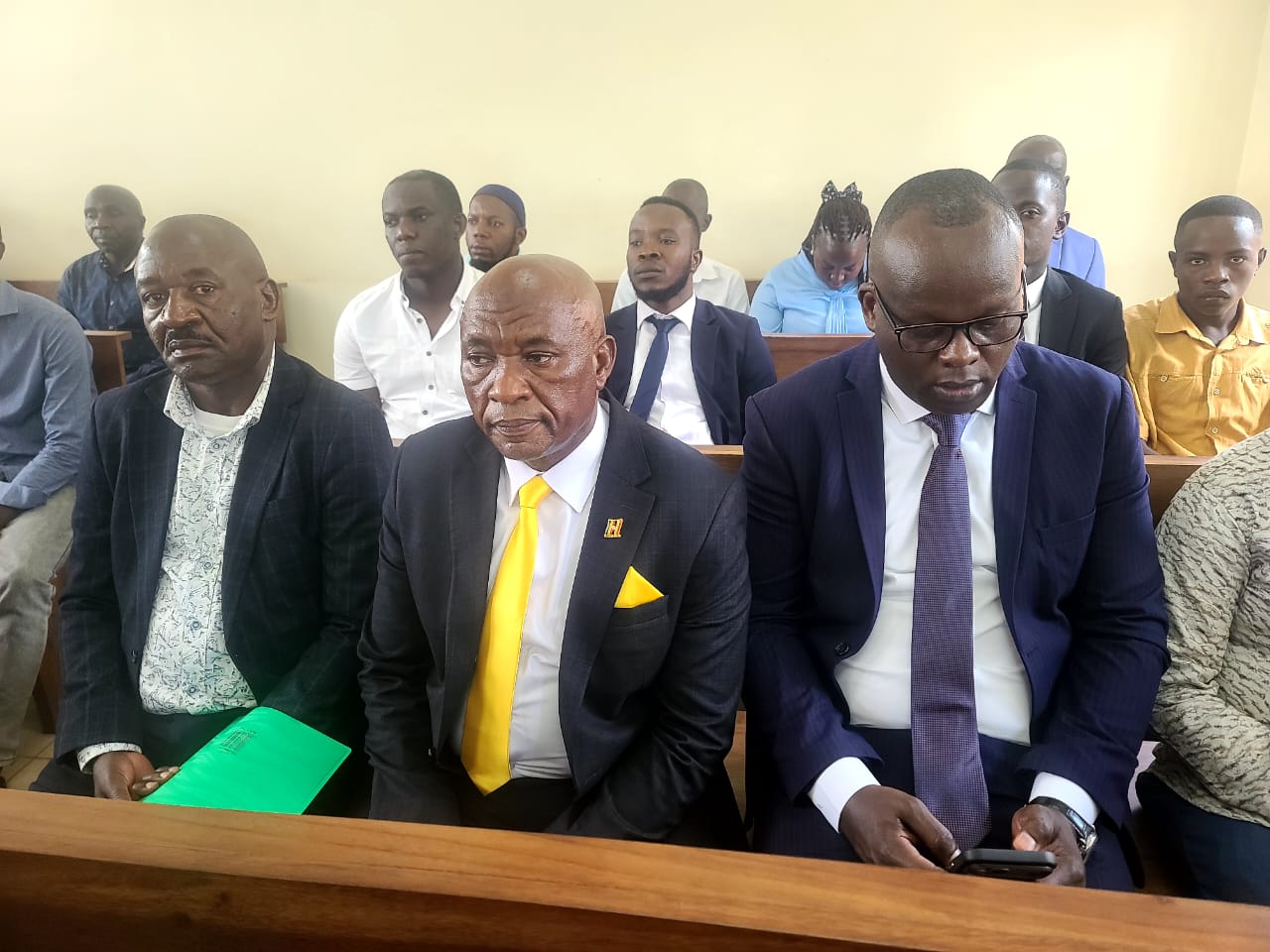
Proceedings at the Wakiso High Court took an unexpected turn on Friday when National Resistance Movement (NRM) candidate Hajji Abdul Kiyimba told court that he was illiterate, prompting questions about his academic background and the circumstances under which he signed his election petition.
Kiyimba, who is challenging the election of Busiro East MP Emmanuel Matovu Magoola, testified in Luganda before facing a lengthy cross-examination by Magoola’s lawyer, Abdul Katuntu, who focused largely on inconsistencies in Declaration of Results (DR) forms submitted as evidence in the petition.


The issue of language arose after Kiyimba’s lawyer introduced him as a witness and asked which language he preferred to use. Presiding judge Justice George Okello questioned why the matter was being raised at that stage, prompting Kiyimba to indicate that he was more comfortable giving his testimony in Luganda.
Attention soon shifted to his literacy status after his lawyer reminded court that Kiyimba had executed both the election petition and its supporting affidavit as an illiterate person under the Illiterates Protection Act.
The law provides safeguards for people who cannot read or write, requiring that documents they sign be read out, interpreted and explained to them in a language they understand. A certificate confirming that the procedure was followed must also accompany the documents.
Justice Okello appeared surprised by the claim, particularly given that Kiyimba had contested a parliamentary seat for which the law requires candidates to possess at least an Advanced Level certificate or an equivalent qualification.
When asked whether he had attended school, Kiyimba confirmed that he had and attempted to recall his Uganda Certificate of Education (UCE) and Uganda Advanced Certificate of Education (UACE) results. However, he struggled to clearly explain some of his grades, drawing reactions from supporters of both candidates in the courtroom.
Kiyimba told court that he sat his UACE examinations in 2014 at Nakifuma High School in Mukono District. Justice Okello subsequently asked to inspect his academic documents and later expressed satisfaction with the results.
The judge also inquired whether Kiyimba had undertaken any further studies. He said he had not. However, Justice Okello directed that the questioning on his academic qualifications should stop, explaining that the matter was not among the issues the court was required to determine in the petition.
During cross-examination, Katuntu challenged Kiyimba’s representation in the court documents that he could neither read nor understand English. He sought clarification on whether the petitioner was genuinely unable to comprehend the English language used in the petition and supporting affidavit.
Kiyimba remained silent for nearly a minute before saying that he could read English but sometimes struggled to understand certain things. Justice Okello intervened, assuring him that the proceedings were not intended to intimidate, condemn or embarrass him.
Katuntu then asked whether presenting an inability to read or understand English as a fact when it was untrue would amount to misleading the court. Kiyimba agreed that doing so would constitute deception.
The questioning subsequently moved to the disputed Declaration of Results forms, which form the central documentary evidence in the petition.
According to results officially announced by the Electoral Commission (EC), Magoola secured 45,625 votes against Kiyimba’s 28,499. However, Kiyimba argues that a proper tally of certified DR forms obtained from the Commission would produce a different outcome and establish him as the rightful winner.
The forms record votes counted at individual polling stations and are among the key documents used to verify and establish final election results. Any inconsistencies between competing copies could therefore become significant in determining whether the declared results were accurate and whether alleged irregularities affected the outcome.
During the proceedings, Katuntu drew attention to one of the forms presented by Kiyimba, which indicated that he had obtained 390 votes in figures but recorded the same tally in words as thirty-nine.
Katuntu then presented another version of the form obtained by Magoola’s team, which showed Kiyimba’s tally as 39 in both figures and words.
Asked to explain the discrepancy, Kiyimba said the document had been obtained from the Electoral Commission and that he could not explain why the figures differed. He maintained that the documents he submitted were certified by the Commission, which is also a respondent in the case and, according to the proceedings, had not produced alternative versions.
Further scrutiny revealed other inconsistencies, including forms in which the number of recorded voters appeared to exceed the number of ballot papers issued. Other disputed documents reportedly contained variations in the names of presiding officers and differences in the identification of candidates’ polling agents.
Kiyimba repeatedly said he could not account for the discrepancies, explaining that he had not prepared the documents and was therefore not in a position to explain the variations.
Katuntu told court that the defence intends to examine about 80 disputed DR forms, indicating that the authenticity and accuracy of the documents will be a major focus as the hearing progresses.
The defence also plans to compare the contested forms with copies issued to agents of other parliamentary candidates, alongside corresponding electoral records from other positions contested on the same polling day, including the Woman Member of Parliament race.
According to the defence, the comparisons are intended to establish which versions of the results forms are authentic and determine whether the differences resulted from errors, alterations or other irregularities.
Kiyimba remains the petitioner’s only witness, leaving his testimony and the documentary evidence he has presented at the centre of his case.





 English
