














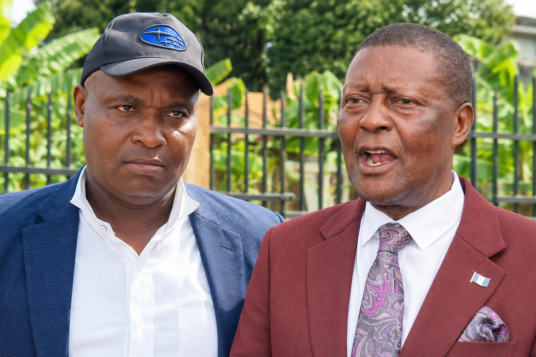
The High Court in Mukono has heard an unusual concession in the election petition challenging the victory of National Resistance Movement (NRM) candidate Francis Lukooya Mukoome, with lawyers for both the candidate and the Electoral Commission acknowledging that irregularities, mathematical errors and alterations occurred during the tallying of results.
The admissions came as the court concluded the hearing of a petition filed by National Unity Platform (NUP) candidate Johnson Muyanja Ssenyonga, who is challenging Lukooya’s election as Mukono District chairperson.

Humphrey Ategeka, who represented Lukooya, and Ahmed Lugolobi, representing the Electoral Commission, maintained that although errors were recorded at some polling stations, they were not sufficient to invalidate the final result.
Their position puts the disputed election at the centre of a legal question: whether the acknowledged errors and irregularities were substantial enough to have affected the outcome of the election.
The Electoral Commission has previously acknowledged in court that errors occurred during tallying, while evidence also showed that results from four polling stations were excluded from the final tally.
The petition arises from the dramatic events at the Mukono District tally centre on January 23, when Returning Officer Emily Amongin made two declarations for the same LC5 election.
According to evidence before court, Amongin initially declared Muyanja the winner with 51,686 votes against Lukooya’s 50,254. Independent candidate Reuben Ssenyonjo had 2,995 votes.
The declaration was later reversed, with Lukooya announced as the winner after a revised tally gave him 52,523 votes against Muyanja’s 52,105. Ssenyonjo’s tally was revised to 3,095.
Lukooya therefore emerged with a margin of 418 votes. The two declarations and the circumstances surrounding the reversal form a central part of Muyanja’s petition.
Muyanja’s lawyers have argued that the reversal was accompanied by irregularities in the handling of declaration of results forms and other election materials.
The petitioner also alleges that security personnel and NRM officials interfered with the tallying process and that results were altered or swapped in favour of Lukooya.
Those allegations remain contested and have not been determined by the court.
In their submissions, Lukooya’s lawyers did not attempt to portray the election process as completely free of mistakes.
Instead, they acknowledged that problems occurred at individual polling stations, including UCU J-E, Basiima Kikooza and Kisoga Central.
The defence position was that the existence of errors does not, by itself, invalidate an election.
The lawyers argued that the court must consider whether the irregularities complained of materially affected the result before exercising its power to annul an election.
The Electoral Commission similarly maintained that Lukooya obtained the highest number of votes after the available results had been tallied and that the final declaration therefore reflected the Commission’s position on the winner.
The court also heard evidence that results from four polling stations were not included in the final tally.
The affected stations were Madujju Mosque, Mpunge Primary School in Busooke-Kikeera, Mpunge NAK-Z and Buwujja Faith Nursery School.
The four stations had a combined 1,942 registered voters.
Amongin told court that voting took place at the stations but that the Electoral Commission did not receive their results.
She also confirmed that violence had been reported in some of the affected areas.
The petitioner’s lawyers questioned how Lukooya could be declared winner by 418 votes when results from polling stations with a combined 1,942 registered voters had not been included in the tally.
During re-examination, however, Electoral Commission lawyer Lugolobi asked Amongin to explain the omission.
She said that where results were not received, the relevant sub-county supervisor reported the matter and the affected polling station was not included in the final tally.
She maintained that after the available results had been tallied, Lukooya had obtained the highest number of votes.
The court also heard direct admissions from presiding officers about errors appearing on declaration of results forms.
At Nasuuti UCC J-T, presiding officer Yulian Nalwanga recorded 95 votes for Lukooya, zero for Muyanja and 95 for Reuben Ssenyonjo.
The same form indicated that 95 male and female voters had turned up and that the number of valid votes cast was 95.
When questioned about the figures, Nalwanga could not explain how Lukooya and Ssenyonjo could each have 95 votes when only 95 valid votes were recorded.
She acknowledged that there could have been an error in tallying.
Another presiding officer, Godfrey Nsamba, was confronted with a similar discrepancy at Kisoga Central.
The declaration form indicated that 209 females and 160 males had voted, giving a total of 369 voters.
However, the results recorded on the same form gave Lukooya 355 votes, Muyanja 30, Ssenyonjo two and two invalid votes, producing a total of 389 votes.
Nsamba conceded that there had been an error in the tallying.
He explained during re-examination that discrepancies could occur when voters were confirmed in the register but were subsequently rejected by biometric verification machines.
The court also examined the declaration form from Basiima Kikooza Catholic Church.
Presiding officer Luke Byamukama acknowledged that the form contained crossings and figures written over earlier entries, although he initially rejected the suggestion that the figures had been crossed out.
A copy presented to court showed 14 votes for Lukooya, while a certified copy contained a figure of 300 written over the earlier entry.
Byamukama denied imposing the figures.
He nevertheless told court that he had initially started with the actual votes but, due to pressure, ended up with different figures.
During re-examination, he maintained that voting had proceeded smoothly and said he initially filled in the correct figures consciously.
The competing versions of the forms have become part of the petitioner’s broader argument that the declaration of results was affected by irregularities.
Muyanja’s lawyers have asked the court to nullify Lukooya’s election, arguing that the irregularities, missing returns and disputed declaration forms affected the credibility of the final result.
Earlier in the proceedings, the petitioner sought to rely on audio and video recordings made by journalists during the declaration of results.
Justice Mwaka rejected the recordings after finding that the petitioner had failed to establish the chain of custody necessary to authenticate the electronic evidence.
The court also rejected a supplementary affidavit seeking forensic examination of 22 declaration of results forms after the respondents objected to its introduction at that stage of the proceedings.
The defence has urged the court to distinguish between the existence of errors and their legal effect on the election result.
Lukooya’s lawyers argue that even where mistakes occurred, the petitioner must demonstrate that they substantially affected the outcome before the election can be annulled.
The petitioner, on the other hand, maintains that the combination of the double declaration, missing polling-station returns, disputed figures and alleged alterations demonstrates that the final result did not accurately reflect the voters’ choice.
The court is now expected to determine whether the irregularities established during the hearing were substantial enough to affect the result and warrant the annulment of Lukooya’s election.
Muyanja’s lawyer John Nalela confirmed after the hearing that the parties had completed presenting their cases and were awaiting the court’s decision.
Justice Mwaka is scheduled to deliver the judgment on November 11, 2026.
ENDS.






 English