

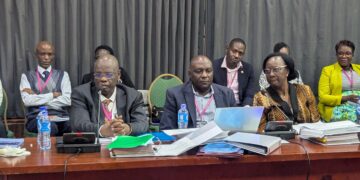
















The Judiciary has entered the final preparations to handle 118 election petitions arising from Uganda’s 2026 parliamentary and local government elections, with judges working to ensure the disputes are resolved within the timelines provided by law.
Chief Registrar Agnes Alum said administrative arrangements are being concluded across the various High Court circuits before hearing dates are communicated to the parties involved.


Speaking during a media briefing at the Supreme Court in Kampala on Wednesday, Alum said the Judiciary was aware of the public interest surrounding the petitions and remained committed to handling the cases within the required legal deadlines.
She explained that judges are currently organizing the allocation of cases and preparing hearing schedules, which will be shared once the process is complete.
“Election petitions are time-sensitive matters, and the Judiciary is making arrangements to ensure they are handled within the timelines provided by the law,” Alum said.
The petitions challenge results from the 2026 parliamentary and local government elections, with several involving prominent political figures across the country.
Among the notable cases is a petition filed by Mawokota North legislator Dr. Hilderman challenging the election of former Trade Minister Amelia Kyambadde. In Mbarara, former Rushenyi County MP Mwesigwa Rukaari is contesting the victory of Christopher Bakashaba, while former Tororo District Woman MP Sarah Opendi has challenged the election of Angella Akoth.
In Mukono High Court, Birungi Kobusingye has petitioned against the victory of NUP’s Harriet Nakwedde in the Kayunga District Woman MP race, with the Electoral Commission named as a respondent.
The Masaka High Court circuit is also expected to handle several high-profile petitions. Rose Nalubowa is challenging the election of NRM’s Justine Nameere as Masaka City Woman MP, while Muwonge Nkoko has filed a petition against the election of Lwengo District Woman MP Cissy Namujju Dionizia.
Other petitions in the circuit include a challenge against Ruth Katushabe’s victory as Bukomansimbi District Woman MP by Grace Nalubega, and a dispute filed by incumbent Ssembabule Woman MP Mary Begumisa against the election of Florence Nambazira.
In Moroto, State Minister Esther Davinia Anyakun’s victory is being challenged by Lilly Lapowa, while other circuits including Iganga and Lira are also handling multiple election-related cases.
Under the Parliamentary Elections Act, courts are required to determine election petitions within specific periods after all parties have submitted their responses.
Alum declined to comment on whether adequate funds had been provided to support the hearings, saying election petition management falls under the office of the Principal Judge.
Judiciary Moves To Address Accountability Concerns
Beyond election disputes, Alum said the Judiciary is strengthening mechanisms to address allegations of corruption and misconduct among judicial officers.
She said the Inspectorate of Courts and the Judicial Service Commission’s disciplinary structures are actively investigating complaints and taking action where evidence of wrongdoing is established.
However, she urged members of the public to provide credible evidence to support investigations instead of making unsubstantiated accusations.
On concerns over delays in processing bail applications, Alum said suspects appearing before magistrates’ courts have a right to make oral bail applications and should not face unnecessary procedural barriers.
She attributed delays in hearing new cases to increasing workloads and case management challenges, saying the Judiciary would continue engaging judicial officers to improve efficiency and communication with court users.
Court Reporting Guidelines In The Pipeline
The Chief Registrar also said the Judiciary will investigate complaints from journalists who have alleged being denied access to proceedings, particularly in politically sensitive cases.
She revealed that the institution is finalising Media and Court Reporting Guidelines alongside a nationwide media accreditation programme aimed at improving cooperation between courts and journalists.
The guidelines are expected to promote accurate reporting while ensuring transparency in judicial proceedings.
Alum further highlighted ongoing reforms within the Judiciary, including expansion of the Electronic Court Case Management Information System (ECCMIS), increased use of virtual hearings, adoption of artificial intelligence-assisted transcription and judgment writing tools, and recruitment of more judicial officers and support staff.
She also announced that the annual High Court and Magistrates’ Court vacation will run from July 15 to August 15, while the Supreme Court and Court of Appeal will take their recess throughout August.
Despite the vacation period, court registries will remain operational to receive new cases, while judicial officers will use the period to prepare pending judgments and rulings.










 English