













A political dispute is taking shape over the manner in which Uganda’s Leader of the Opposition (LOP) is chosen, after two legislators announced plans to introduce legislation seeking to transfer the power of selecting the office holder from political parties to Parliament.
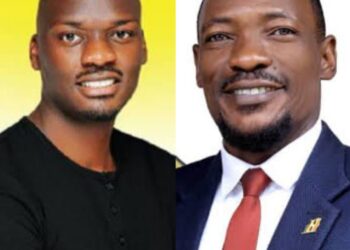
Kibanda North MP Linos Ngompek and Buyaga West MP Denis Namara, both associated with the Patriotic League of Uganda (PLU), have notified the Speaker of Parliament of their intention to seek leave to table the Administration of Parliament (Amendment) Bill, 2026.

The proposed legislation would alter the current arrangement under which the Leader of the Opposition is nominated by the opposition party holding the largest number of seats in Parliament. Instead, the lawmakers want the position to be filled through an election conducted among Members of Parliament.
In a notice copied to the Deputy Speaker and the Clerk to Parliament, the legislators stated that they intended to move a motion under Rule 58 of Parliament’s Rules of Procedure seeking permission to introduce the Private Member’s Bill.
Addressing journalists after submitting the notice, Namara argued that the existing system grants excessive influence to a single political party and limits participation by other opposition legislators.
He said the Leader of the Opposition plays a parliamentary role and should therefore derive legitimacy from Parliament itself, rather than being selected by leaders of one party.
According to Namara, opposition MPs outside the largest opposition party are often excluded from the decision-making process.
The move revives a long-standing debate about whether the Leader of the Opposition should continue to be nominated by the largest opposition party or be elected by all opposition MPs.
Article 82A of the Constitution establishes the office of the Leader of the Opposition, while the Administration of Parliament Act provides that the largest opposition party in Parliament nominates the holder of the office, whose appointment is subsequently announced by the Speaker.
Following the reorganisation of parliamentary leadership in May 2026, the National Unity Platform (NUP), which commands 48 seats and remains the biggest opposition party in the House, retained Joel Ssenyonyi as Leader of the Opposition. The appointment was formally communicated by Speaker Jacob Oulanyah Oboth-Oboth in accordance with the law.
The law currently provides that the office becomes vacant only when the holder resigns, loses his or her parliamentary seat, ceases to belong to the nominating party, is replaced by that party, or when another opposition party surpasses it in parliamentary numbers. Parliament itself has no legal mandate to elect or dismiss the Leader of the Opposition.
The proposed amendment resembles a 2024 Bill sponsored by former Mityana South MP Richard Lumu. That proposal sought to have all opposition MPs elect the Leader of the Opposition, subject the Shadow Cabinet to parliamentary approval, broaden the grounds for removing the opposition leader, and require wider consultations in appointing committee chairpersons.
The initiative attracted criticism from opposition parties, constitutional scholars and governance analysts, who argued that it would erode the autonomy of political parties protected under Articles 71 and 72 of the Constitution and depart from the Westminster parliamentary tradition. The Bill was later withdrawn in March 2026 after consultations.
The latest proposal comes only days after Chief of Defence Forces Gen. Muhoozi Kainerugaba posted on X that he had directed PLU members to explore ways of removing Joel Ssenyonyi from the office of Leader of the Opposition. In another post, he suggested that efforts to appoint “our own Leader of the Opposition” were already underway.
The comments sparked debate over the involvement of serving military officers in partisan political discussions, given the Constitution’s provisions requiring the Uganda People’s Defence Forces to remain non-partisan.
Alice Alaso, the Acting National Coordinator of the Alliance for National Transformation (ANT), warned that the developments reflected a growing concentration of power within state institutions.
She said those in authority already wield influence over the Executive, Parliament and the security agencies, cautioning that failure to reverse the trend could plunge the country into instability.
Senior lawyer and former Busiro East MP Medard Lubega Sseggona also questioned the viability of the proposal, arguing that the current constitutional framework does not provide a basis for Parliament to remove the Leader of the Opposition.
Uganda’s 12th Parliament consists of 359 National Resistance Movement legislators, 48 NUP MPs, 12 from UPC, nine from FDC, six from DP, two from the People’s Front for Freedom, one ANT representative and 69 Independents.
Parliament is currently on recess and is expected to resume sittings on July 7, 2026.








 English