



















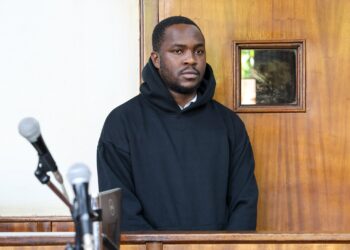
A man from Wakiso District who spent two years in prison for threatening violence has had his conviction and sentence quashed by the High Court after a judge found that the trial court failed to follow proper procedures when recording his guilty plea.
In a ruling delivered on June 19, 2026, Justice Gadenya Paul Wolimbwa of the High Court Criminal Division nullified the conviction of Ssaka Sam, saying the plea that formed the basis of his imprisonment was taken irregularly and was therefore invalid.


Court records show that Ssaka was charged with threatening violence under Section 81(a) of the Penal Code Act. Prosecutors alleged that on June 11, 2024, at Kijabijjo “B” in Kira Municipality, Wakiso District, he threatened to injure, assault or kill a complainant with the intention of intimidating or annoying them.
On June 19, 2024, Ssaka appeared before Kasangati Chief Magistrate’s Court, where he pleaded guilty to the charge and was immediately sentenced to two years in prison by Grade One Magistrate Nangobi Miria Jackie.
The case later reached the High Court for mandatory confirmation of sentence, prompting Justice Wolimbwa to review the proceedings.
Upon examining the record, the judge found that although the charge and its particulars had been read and explained to the accused, the prosecution’s facts outlining the circumstances of the offence were never read to him for confirmation.
Justice Wolimbwa noted that established law requires courts to read out the facts supporting a charge to an accused person before accepting a guilty plea. This procedure ensures that the accused fully understands the allegations and voluntarily admits them.
He cited the landmark East African case of Adan v Republic (1973), which sets out the requirements for taking guilty pleas, as well as provisions under Section 124 of the Magistrates Courts Act.
“The Respondent was never afforded the opportunity to admit or deny the factual basis of the charge, rendering the plea equivocal and the conviction entered in error,” the judge ruled.
Justice Wolimbwa observed that the defect made the conviction illegal and rendered the subsequent two-year sentence devoid of any lawful foundation.
The court, however, noted that by the time the matter was reviewed, Ssaka had already completed serving the entire prison term.
“It is regrettable that by the time this matter reached the High Court, the Respondent had already served the full sentence,” Justice Wolimbwa said.
Despite the sentence having been fully served, the judge emphasized that the court still had a duty to correct an unlawful criminal record.
“A conviction entered upon an equivocal plea is a nullity, and it ought not to stand merely because the sentence has run its course,” he added.
The High Court consequently set aside Ssaka’s guilty plea, quashed the conviction and vacated the two-year sentence, directing that the court record be amended to reflect the decision.
The ruling underscores the importance of strict adherence to plea-taking procedures in criminal cases, with the High Court warning that failure to observe such safeguards can lead to wrongful convictions and unlawful imprisonment.











 English