








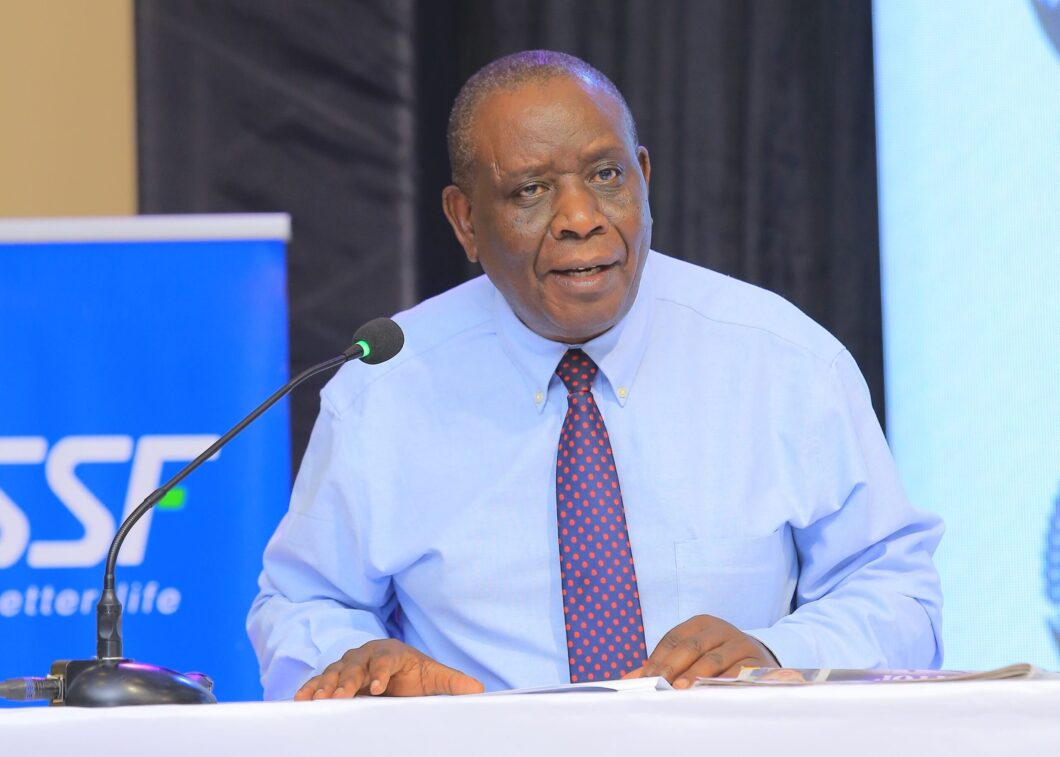
Veteran historian and political commentator Mwambutsya Ndebesa has launched a scathing critique of Uganda’s anti-corruption campaign, arguing that powerful public officials are only investigated after losing political protection.
Speaking during a public lecture on governance and accountability, Ndebesa claimed corruption in Uganda operates under an unwritten system of political patronage where senior officials accused of abuse of office remain untouchable for as long as they enjoy favour within the political establishment.

At the centre of his remarks was former Speaker of Parliament Anita Annet Among, whose recent troubles he described as evidence of how accountability in Uganda is shaped by political survival rather than the rule of law.
“In Uganda, corruption is licensed,” Ndebesa said. “As long as you still have political backing, nobody touches you. Once that protection is withdrawn, the system suddenly remembers there is corruption.”
His comments come at a time when Among faces mounting scrutiny over allegations of abuse of office and self-enrichment, issues that have intensified public debate about corruption and accountability within government institutions.
Ndebesa argued that the former Speaker’s predicament illustrates what he called selective justice, where institutions mandated to fight corruption only become active after political alliances shift.
According to him, Uganda’s anti-corruption agencies often struggle to act independently against influential figures who remain politically connected.
He pointed to the AGORA parliamentary exhibition last year, which exposed alleged misuse of public funds and controversial allocations to parliamentary commissioners, saying the revelations generated public outrage but failed to trigger immediate action from state institutions.
“People spoke out, evidence was displayed publicly, but nothing happened at the time,” he said. “The institutions remained silent because the political license was still intact.”
The historian maintained that corruption in Uganda should not only be viewed as theft of public resources but also as a political system sustained by patronage, protection, and loyalty networks.
He criticized what he described as superficial anti-corruption campaigns that target minor offenders while avoiding deeper political structures that enable large-scale abuse of public funds.
Ndebesa also revisited the controversy surrounding what President Yoweri Museveni previously described as “budget corruption” during disagreements over the national appropriation process.
He noted that several legislators, including Yusuf Mutembuli, Paul Akamba and Cissy Dionizia Namujju, were arrested amid corruption allegations before the charges were later dropped.
To Ndebesa, the developments exposed inconsistencies within the justice system and raised fresh questions about whether anti-corruption drives are genuinely independent.
“And when the cases disappeared, the institutions also went quiet,” he said. “That is why many Ugandans no longer believe the fight against corruption is serious.”
The historian further accused political actors of normalising bribery within electoral processes, including internal elections in the ruling National Resistance Movement.
He claimed voter inducement had become openly visible during contests for positions on the party’s Central Executive Committee, with allegations of candidates openly buying support in full public view.
“It was discussed on radio stations, shown on television, and witnessed by many people,” he said. “But nobody was held accountable.”
Ndebesa warned that unless Uganda strengthens the independence of institutions such as Parliament, the judiciary, and anti-corruption agencies, public trust in governance will continue to decline.
He also defended the role of journalists, civil society organisations, whistleblowers, and activists, arguing that exposing corruption publicly often produces more results than relying solely on internal accountability systems.
According to him, restricting civic space and intimidating critics only weakens transparency and shields abuse of power from scrutiny.
The lecture, held under the theme of public trust and accountability, evolved into a broader reflection on the relationship between political power and corruption in Uganda, with Ndebesa insisting that meaningful reform will remain elusive unless the country confronts what he described as the political foundations of corruption itself.






 English