













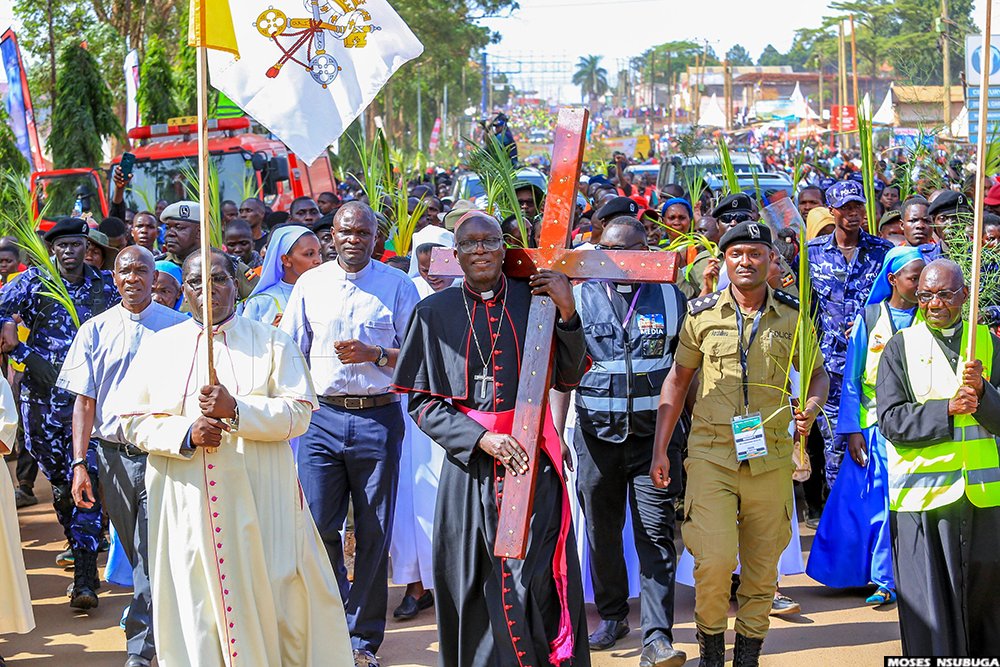
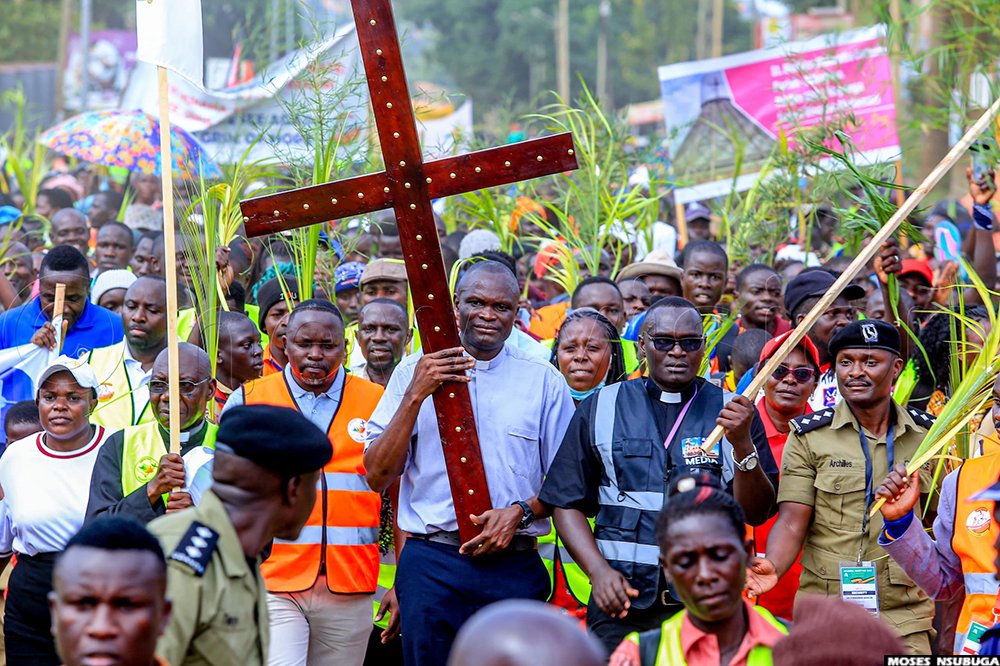
As pilgrims from across Uganda and beyond converge on Namugongo for the 2025 Uganda Martyrs Day celebrations, this year’s host—Lugazi Diocese—brings to the forefront a powerful but often overlooked chapter in Uganda’s Christian history: the legacy of the Mill Hill Missionaries.
While the Uganda Martyrs’ story is most commonly associated with the White Fathers (Missionaries of Africa), who arrived in 1879 led by Fr. Lourdel “Mapeera” and Brother Amans, the Mill Hill Missionaries also played a crucial role in the spread of Catholicism and made significant contributions to the veneration of the Uganda Martyrs.
Msgr. Richard Kayondo, Vicar General of Lugazi Diocese, explains: “They undoubtedly laid the foundation for what is now Lugazi Diocese. They were among the first to honor the Uganda Martyrs in a formal and organized way.
Not only did they play a pivotal role in spreading the faith in eastern Uganda, but they also championed the memory and cause of the young converts who had courageously shed their blood for Christianity.”
Historical records reveal that the first official pilgrimage to Namugongo was led by the Mill Hill Fathers, under Rev. Fr. Stephen Walters. This momentous event occurred on June 6, 1920—the very day Pope Benedict XV beatified the Uganda Martyrs.
Following that pilgrimage, Fr. Walters proposed building a church over the grave of St. Charles Lwanga, on the very site where twelve of the martyrs were burned. His vision marked a significant step in preserving the sacred memory of the martyrs and laid the foundation for what has become a global center of pilgrimage.
The Mill Hill Fathers built a church at Namugongo that stood for over three decades, serving as both a place of worship and a symbol of their early missionary efforts. However, with the plans for constructing the current basilica, the original church was eventually demolished.
The demolition stirred mixed emotions. Some Mill Hill Missionaries and local faithful, whose communities had been evangelized by the missionaries, expressed deep sorrow over the loss.
Tensions arose with the new administration under the Archdiocese of Lubaga, which had assumed oversight of the site. For many, the original church was more than a building—it was a testament to missionary sacrifice, community faith, and a living history of devotion.
The Arrival and Early Mission
Founded in England, the Mill Hill Fathers were invited to Uganda in the early 1890s at the request of Bishop Livinhac, head of the White Fathers. In a letter to Cardinal Herbert Vaughan dated January 1892, Livinhac stressed the need for English missionaries in Uganda.
“Bishop Livinhac had told Vaughan in January 1892 that it was urgent to have English missionaries in Uganda… Livinhac proposed he would give up the northeastern portion of the Nyanza Vicariate,” wrote Fr. Robert O’Neil in Mission to the Upper Nile.
One reason for this shift, according to H. P. Gale in Uganda and the Mill Hill Fathers (1959), was to counter a prevailing local belief that Protestantism was linked to the English while Catholicism was inherently French.
This perception was especially strong in eastern Buganda, where Anglican missionaries had already established a strong presence.
The first group of Mill Hill missionaries departed London on May 9, 1895, arriving in Kampala on September 6 of the same year. They quickly established their base at Nsambya Hill, where they built St. Peter’s Proto-Cathedral, a key center for evangelization, education, and healthcare.
The mission, later designated the Vicariate of the Upper Nile, expanded eastward—encompassing today’s Lugazi Diocese, and extending into Busoga, Bugisu, Bukedi, Teso, and parts of Kenya. Just ten months after arriving, the missionaries opened their first outstation at Naggalama in July 1896.
Interestingly, the land for this mission was donated by a Protestant chief, Thomasi Semukassa. Much of their early evangelization focused on this Kyaggwe area (modern-day greater Mukono), including the establishment of their third mission at Mulajje—now known as Nkokonjeru, meaning “the white hen.”
According to local folklore, the name Nkokonjeru came from a Mukowe tree struck by lightning, believed in Ganda tradition to be the fiery hammer (nyondo) of the gods, accompanied by a mystical white hen whose flaming feet scorched the land. The tree, feared as the dwelling place of a spirit (Lubale), made the area a site of traditional worship.
“It was in this dark haunt of paganism that the new mission started. But the mission was full of hope,” Gale wrote.
Building Institutions and Changing Lives
Additional mission stations were later established in Nyenga (then called Busale), Nazigo, Kome, and the Buvuma Islands. These would grow into vital Catholic centers with schools, hospitals, farms, and community services that continue to thrive.
In 1902, the mission was further strengthened by the arrival of Franciscan Sisters from St. Mary’s Abbey, Mill Hill, led by Kevin Teresa Kearney.
Their care for the sick at Nsambya marked the beginning of Uganda’s Catholic healthcare tradition. Mother Kevin later founded the Little Sisters of St. Francis, whose legacy continues to impact Lugazi and other regions.
Bishop Hanlon, also in 1902, began laying a foundation for Catholic education within the Vicariate. Letters from Naggalama and Nazigo detail his plans, including building schools and introducing teaching materials like benches and blackboards. That same year, St. Peter’s Primary School in Nsambya opened.
By 1907, it had a permanent structure and 40 enrolled boys. By 1909, it had evolved into a secondary school—what would become one of Uganda’s foremost Catholic educational institutions.
In 1910, Naggalama received its first school, when Gerald Mulder brought an assistant to help catechists teach literacy using a cloth with painted letters.
“The catechists, many of whom could not read or write, were instructed at the mission on how to teach the alphabet,” O’Neil recorded.
One of the most prominent educational initiatives was Namilyango College, founded in response to a 1901 request by Stanslaus Mugwanya and a 1902 appeal by Katikkiro Apolo Kagwa.
The college opened in March 1902 with ten boys, mainly Buganda princes—including sons of Kiweewa and Kalema—who had embraced the Catholic faith.
Transition and Legacy
The Second Vatican Council (1962–1965) ushered in a call for indigenous leadership. In 1965, Bishop Joseph Billington (MHM) stepped down as head of the then Kampala Diocese, which included areas of modern Lugazi.
In 1966, this diocese was merged with the Archdiocese of Lubaga, and Emmanuel Nsubuga—later Uganda’s first Cardinal—became Archbishop.
Three decades later, in November 1996, the Diocese of Lugazi was officially established, reviving a regional identity rooted in Mill Hill missionary work. Bishop Matthias Ssekamanya, then Auxiliary Bishop of Kampala, was appointed as its first bishop.
As Lugazi Diocese leads this year’s Martyrs Day celebrations at Namugongo, it honors not only the Uganda Martyrs but also the Mill Hill Missionaries who planted and nurtured the faith across the region. Their enduring legacy of humility, perseverance, and service continues to shape the life of the Church today.
“We thank God that the work of the early missionaries has borne such great fruit across our diocese—from Naggalama to Nkokonjeru, Namiryango to Buvuma, and back to Namagunga, the first and oldest parish in our diocese founded by our ancestors in faith after Nsambya,” said Rev. Fr. Joe King, MHM Regional Superior for Uganda and Kenya, in a message marking Lugazi Diocese’s 25th anniversary.
“We are proud that to this day, the Mill Hill Missionaries remain present and active in the diocese,” he added.




 English