
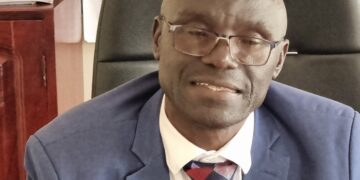

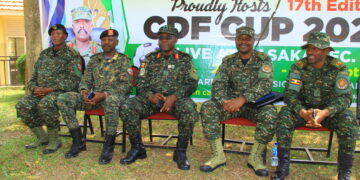
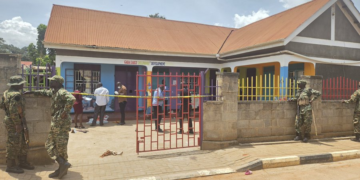












The Minister for Defence and Veteran Affairs, Jacob Oboth-Oboth, has thrown his full support behind Uganda’s security forces following the killing of a second female suicide bomber at Kalerwe Market, citing public safety as the government’s top priority in the face of escalating terror threats.
Speaking on Monday shortly after his nomination as the NRM flag bearer for West Budama Central Constituency, Oboth-Oboth made it clear that security agencies acted appropriately in neutralizing the suspect. He challenged critics who questioned why the suspect was not apprehended alive.

“How do you arrest somebody with a bomb? These are suicide bombers. They are a bomb,” Oboth-Oboth stated firmly while addressing journalists at the NRM Electoral Commission headquarters in Kampala. “Next time, maybe when we see one, we shall call you.”
The minister credited intelligence and vigilance for preventing what he said could have been mass-casualty attacks—referring to both the Kalerwe incident and an earlier foiled bombing near Munyonyo Shrine during the Martyrs Day celebrations on June 3.
He emphasized that the threats Uganda faces are not politically driven, but ideologically motivated, citing the continued danger posed by the Allied Democratic Forces (ADF).
“We are surrounded by many threats because of the various interests of terrorists,” he said. “If anyone is complaining about them being put out of action, it’s about balancing the rights of those who are supposed to be saved and the one who has to be put out of action.”
Oboth-Oboth dismissed allegations that the military is overstepping its role in political matters, noting that the Uganda People’s Defence Forces (UPDF) only support electoral processes when requested by police.
“If we, the political players, behave well and are civil, like in other developed countries, there will be no need for UPDF or even the police,” he added. “But some of us have not yet matured politically.”
The minister also warned against divisive politics based on tribe or religion, calling such rhetoric primitive and harmful to national unity. He urged candidates to focus on policy-driven campaigns aimed at improving the lives of Ugandans.
In a demonstration of strong grassroots support, Oboth-Oboth submitted registers with over 32,000 signatures from constituents—far exceeding the 20-nominator requirement.
“Before expressing interest, I first consulted my voters to see if they still want me to contest. What I’ve brought today is that feedback,” he said.
Elsewhere in the country, political momentum is building. In Katakwi District, Cecelia Anyakoit was nominated to challenge Vice President Jessica Alupo for the Woman Member of Parliament seat.
Anyakoit, a former sports administrator and one-time Uganda People’s Congress (UPC) member, pledged to promote unity and equitable access to government programs.
“Opportunities should be fairly distributed, ensuring that both the youth and the elderly benefit from government programs,” she said.
The nominations also saw several other political figures enter the race. Among them were Jotham Taremwa, former Electoral Commission spokesperson, vying for Nyabushozi Constituency; Moses Acrobat Kiiza, eyeing a return to Bughendera Constituency; Brandon Kintu of Kagoma County; and Naome Kibajju for Sheema District Woman MP.
As Uganda prepares for the upcoming election cycle, the stakes are high. National security, political civility, and inclusive governance are set to dominate the campaign trail, with both new and returning candidates promising to shape the future of their constituencies and the country.





 English