








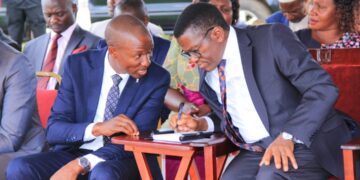






As Uganda heads toward the 2026 general elections, the country’s leading opposition party, the National Unity Platform (NUP), is facing a major legal battle that could derail its electoral strategy and cast doubt on its internal legitimacy.
A group of founding members of the National Unity, Reconciliation and Development Party (NURP), the political organization from which NUP emerged, has petitioned the High Court in Kampala seeking to suspend all party activities.


They claim that the current NUP leadership, under Robert Kyagulanyi Ssentamu, also known as Bobi Wine, is operating under a forged constitution that violates both the party’s original framework and national laws governing political organizations.
The application arises from Civil Suit No. 165 of 2024 and targets the top leadership of NUP.
Petitioners Moses Nkonge Kibalama, Paul Ssimbwa Kagombe, Moses Luyinda, Delwilbert Omomy, and Emmanuel Joseph Kasirye are asking the court to issue a temporary injunction that would halt internal elections, stop the planned delegates’ conference scheduled for June 11, and suspend NUP’s ongoing political activities until the matter is resolved.
The crux of the dispute lies in the legitimacy of the constitution currently being used by NUP.
The petitioners argue that the original 2004 constitution of NURP was secretly altered in 2020 during a controversial delegates’ conference and replaced with a version that granted sweeping powers to the current leadership.
According to the lead applicant, Paul Ssimbwa Kagombe, the altered constitution has been used to exclude founding members from the leadership structure and to centralize power within a small inner circle led by Kyagulanyi.
The applicants further claim that the Electoral Commission wrongly accepted the altered constitution and has continued to recognize an illegitimate leadership.
They are asking the court to compel the Electoral Commission to restore the 2004 constitution and to bar it from disbursing public funds to NUP until the authenticity of the constitution is legally verified.
The lawsuit has triggered intense anxiety within NUP. According to sources within the National Executive Committee who requested anonymity, party leaders have held several emergency meetings since the petition was filed.
These meetings were reportedly focused on legal strategy and ways to maintain party cohesion as the case proceeds.
One NEC member revealed that the leadership is deeply concerned that the court may halt the June 11 delegates’ conference.
This conference is expected to formally swear in new members of the National Executive Committee and reaffirm Kyagulanyi’s leadership.
If the injunction is granted, the event may not take place, leaving the party in organizational limbo just months before critical electoral deadlines.
The petitioners have also accused the current leadership of ignoring democratic norms by failing to hold grassroots elections or competitive internal processes for flag bearer selection.
Instead, they allege that key positions have been filled through direct appointments by Kyagulanyi, further eroding the credibility of the party’s democratic claims.
The Role of the Electoral Commission
The Electoral Commission, named as the seventh respondent in the case, has denied any wrongdoing.
In its response, the Commission maintains that it has acted in accordance with the law and has not played a role in the alleged constitutional irregularities.
However, legal experts suggest that the Commission could still face serious scrutiny depending on how the court rules on the authenticity of the NUP constitution.
If the court finds that the Commission accepted a falsified constitution or failed in its oversight responsibilities, the ruling could set a precedent for greater regulatory accountability in the management of political parties in Uganda.
The Stakes for 2026
With the general elections on the horizon, the legal case presents an existential threat to NUP’s electoral preparations.
A court order freezing party activities would make it impossible to finalize candidate lists, hold primaries, or organize the campaign machinery required for a national election.
Even without a formal injunction, the cloud of legal uncertainty could damage the party’s public image and dampen enthusiasm among its supporters.
Political analysts say the case represents one of the most serious internal challenges Kyagulanyi has faced since taking over leadership of the opposition.
While Kyagulanyi remains popular, the current court battle exposes a critical weakness in how the party was restructured.
“This legal confrontation shows that the party may have been built on shaky procedural ground. If NUP does not resolve this cleanly and quickly, it could affect not only their performance in 2026 but also their credibility as an alternative to the ruling establishment,” our analyst said.
Looking Ahead
The High Court is expected to set a date for the hearing of the injunction application in the coming days.
In the meantime, the NUP leadership is scrambling to preserve unity and press ahead with the planned extraordinary delegates’ conference.
Whether the party can successfully navigate this internal rebellion and emerge ready for national elections remains to be seen.
But one thing is clear: the road to 2026 is now more complicated for Uganda’s most prominent opposition party.
This legal case could redefine not only NUP’s future but also the standards of governance and transparency within Uganda’s political landscape.







 English