


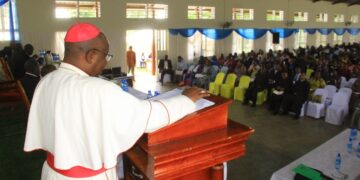











Mbarara City, What began as a routine political gathering for Uganda’s Democratic Party (DP) on Sunday quickly spiraled into turmoil, as security forces stormed the 12th Delegates Conference at Asamar Country Hotel, disrupting proceedings and throwing the party’s internal election into disarray.
The heavy deployment of security personnel, including members of the Police Counter-Terrorism Unit, was triggered by a fierce standoff over the appointment of the conference’s presiding officer.


Party delegates, visibly angered by what they described as an undemocratic imposition, openly rejected the appointment of Kennedy Mutenyo, the former DP Electoral Commission chairperson, who had been designated to oversee the election process.
In an act of defiance, a faction of delegates rallied around Henry Ssempebwa Kigonya, the DP chairperson for Buikwe District, electing him on the spot to lead the voting process. But the resistance was short-lived.
Armed soldiers and police officers descended on the main tent, forcibly ejecting dissenting delegates and abruptly halting the proceedings.
Eyewitnesses reported scenes of chaos as officers tore through crowds, prompting fears of violence.
A verification and clearance process for delegates was then hastily initiated, with several attendees voicing strong resistance.
The disruption came mere hours after the National Executive Committee (NEC) was officially dissolved—a move that left the party without formal leadership at a critical moment.
With the NEC no longer in control, the question of who holds legitimate authority within the party took center stage.
Mutenyo, backed by a faction of former NEC members, remains the only figure officially recognized to preside over the conference. Yet, his authority is being vehemently contested.
“Constitutionally, the presiding officer is supposed to be elected by the delegates, not appointed by whoever wishes,” argued Richard Sebamala, one of the sidelined candidates.
“The former executive members are now ordinary members and have no authority to make decisions in that regard.”
Sebamala, who claims he was illegally removed from the race, represents a growing chorus of voices challenging what they see as a betrayal of the party’s democratic ethos.
A Party at War With Itself
As the day wore on, the conference devolved into a symbol of the deeper divisions tearing through the DP. What was meant to be a show of internal unity and electoral renewal instead laid bare the fractures and power struggles that have plagued the party for years.
Many delegates left the venue disillusioned, uncertain whether the election would proceed or if the outcome—if any—would hold legitimacy.
Political observers say the chaos reflects a broader crisis of governance and internal discipline within Uganda’s oldest political party.
Once a formidable force in the country’s post-independence political landscape, the Democratic Party now finds itself fighting not just for electoral relevance—but for its very identity.
Whether the DP can recover from this weekend’s debacle remains an open question. For now, the Asamar Country Hotel stands as a silent witness to a party teetering on the edge of fragmentation.


 English