

















The Bishop of Masaka Diocese, Rt. Rev. Serverus Jjumba, has raised alarm over the growing habit of improper disposal of used diapers and sanitary pads, describing it as a serious threat to public health and the environment.
Speaking in Kyotera during celebrations to mark the World Day of the Sick, the Bishop said many of the illnesses draining families financially are directly linked to poor hygiene and reckless waste disposal.


He noted with concern that items which were once handled with strict privacy and care are now carelessly dumped in gardens, along roadsides, and in plantations.
“In the past, materials like baby waste and sanitary products were treated with discretion and disposed of properly. Today, we see them scattered in gardens and along pathways. This is not only shameful but dangerous to the entire community,” he said.
The Bishop warned that used diapers and sanitary pads, when left in the open, become breeding grounds for disease and a catalyst for infections that could easily be prevented through responsible behavior.
The remarks came as the Diocese launched its 2025–2026 pastoral theme: “Let us deepen hygiene and environmental protection based in the basic Christian community,” an initiative being spearheaded by Caritas MADDO.
The campaign targets all the districts that make up Greater Masaka, urging residents to adopt practical environmental protection measures at household level.

Among the directives outlined by the Bishop are separating waste at the source by keeping plastics, glass, and organic waste apart, planting at least five fruit trees and five indigenous trees such as bark-cloth (Mituba) trees per household, and ensuring homes have proper drying racks (katandalo), clean latrines, and bathrooms.
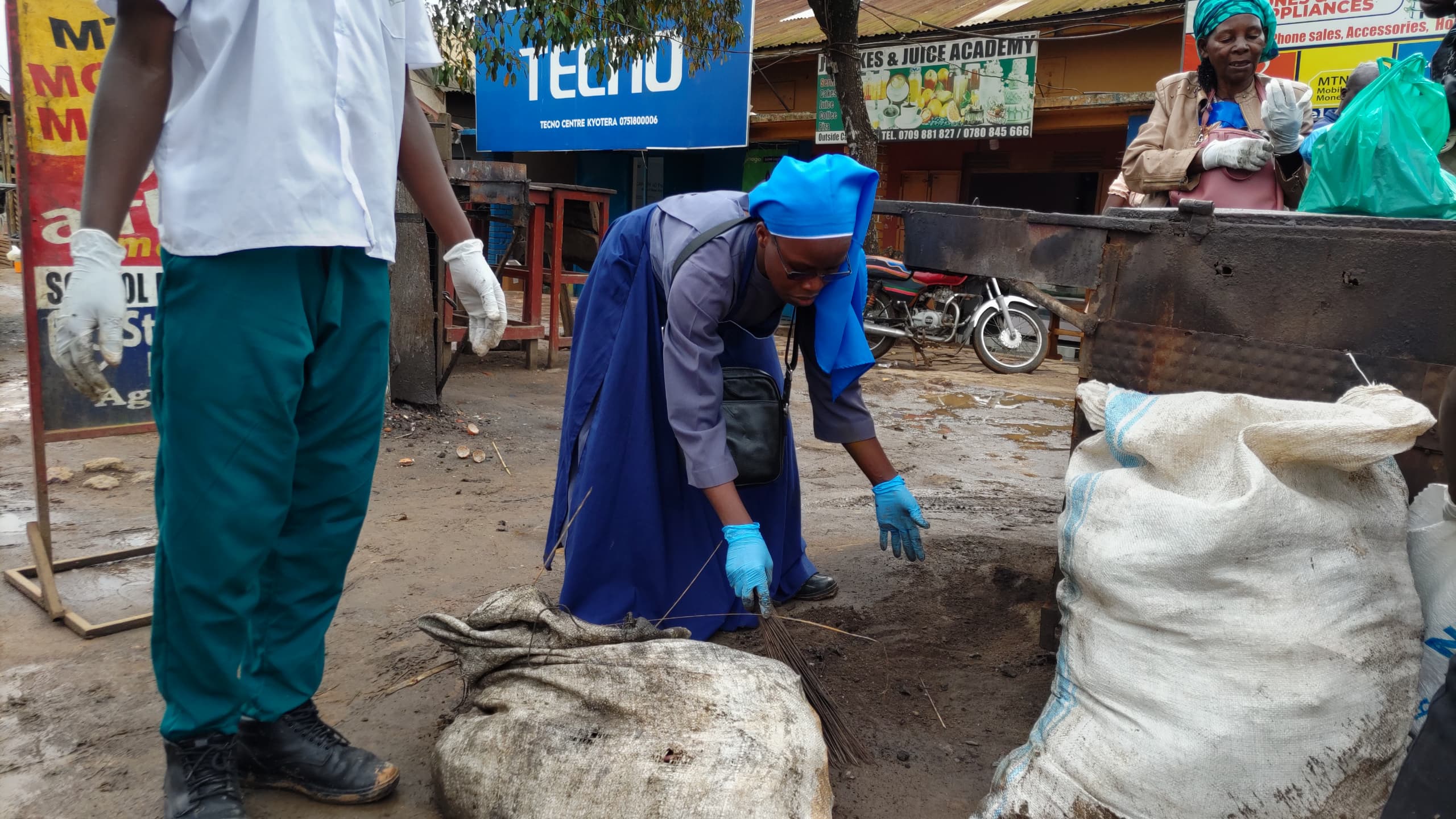
The day’s activities began with a community clean-up exercise, locally known as Bulungi bw’ensi, in Kyotera town. However, priests, religious leaders, and students participating in the exercise were shocked to find used diapers and sanitary pads mixed with general rubbish and dumped directly in people’s plantations.
The Bishop appealed to the public to immediately stop the habit, stressing that environmental care is both a moral obligation and a public health necessity.
Masaka City’s Head of Health Department, Dr. Kasendwa Patrick, echoed the Bishop’s concerns, describing the disposal of used diapers and pads as a major environmental and public health crisis.
He explained that these products are designed for single use but are not biodegradable, containing durable plastics, wood pulp, and superabsorbent polymers that can take between 400 and 1,000 years to decompose.
“Because these wastes contain human excreta, they should ideally be incinerated. The big problem we face in Masaka City and Greater Masaka is that we do not have enough incinerators. Even the sellers of these products do not educate consumers on proper disposal after use,” Dr. Kasendwa said.
He emphasized that responsibility for proper waste management does not rest with the health department alone, but cuts across sectors including environmental officers, farmers, urban authorities, and households.
Health experts warn that soiled diapers and pads contain urine and feces that harbor dangerous bacteria and viruses such as E. coli, Salmonella, and Hepatitis A.
When dumped in open fields or near water sources, they have been linked to outbreaks of cholera, typhoid, diarrhea, and dysentery. Open dumping also attracts flies, rodents, and other pests that carry disease into homes.
Informal waste workers, scavengers, and cleaners who handle such waste without protective equipment face a heightened risk of infection.
Environmental consequences are equally severe. When disposed of near rivers and water bodies, fecal matter can leach into water sources, contaminating them and making them unsafe for drinking, bathing, or fishing.
As diapers and sanitary pads slowly break down, they release microplastics that pollute soil and water and may eventually enter the food chain.
Some residents resort to burning diapers as a disposal method, but this releases toxic chemicals such as dioxins, furans, and carbon monoxide, which can cause respiratory infections and increase the risk of cancer.
Improper disposal also damages infrastructure. Flushing diapers and sanitary pads down toilets causes them to swell and block sewer systems, leading to sewage overflows and costly repairs. When dumped in drains and waterways, they obstruct rainwater flow and increase the risk of flooding during heavy rains.
Wildlife is not spared either. Dogs, pigs, and other animals rummaging through dumping sites may ingest plastic materials, leading to intestinal blockages, injury, or death.
Meanwhile, the sight of used sanitary products strewn across public spaces degrades the natural landscape and undermines community dignity.
Dr. Kasendwa advised that used diapers and pads should be tightly wrapped in plastic bags and placed in designated trash bins.
They should never be flushed down toilets or burned in the open. In areas without formal waste collection systems, burial at least six inches deep or disposal in pit latrines is recommended as a safer alternative.
As the Diocese rolls out its hygiene and environmental protection campaign, leaders hope that combining faith-based mobilization with public health education will help reverse the growing waste crisis and restore cleanliness across Greater Masaka.








 English