


















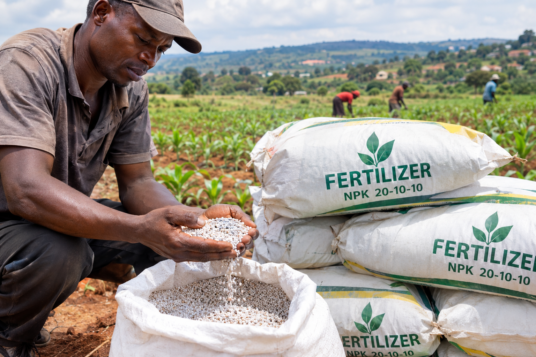
Disruptions to fertilizer supplies linked to the conflict in the Middle East are exposing vulnerabilities in East Africa’s agricultural sector, raising concerns about rising production costs, delayed deliveries and the ability of farmers to sustain crop yields.
Uganda is particularly exposed to international supply shocks, with nearly 40 percent of its fertilizer imports in 2024 originating from the Middle East and Gulf region, according to an analysis published by the Economic Policy Research Centre (EPRC) in June 2026.


The country imported fertilizers worth approximately US$54.75 million in 2024, based on data from the World Integrated Trade Solution cited in the analysis. This reliance on external suppliers leaves farmers vulnerable to fluctuations in international prices and disruptions along shipping routes.
For a country whose agricultural sector supports millions of livelihoods, any significant increase in fertilizer prices could make essential farm inputs less affordable, particularly for smallholder farmers operating with limited financial resources.
The unfolding crisis has also revived a broader debate about the sustainability of agricultural systems that depend heavily on synthetic fertilizers and pesticides manufactured using fossil fuel-based resources.
In a report titled Toxic Dependency: How Agrochemicals Lock In Food System Vulnerability, released on October 13, the Global Alliance for the Future of Food argues that dependence on these inputs exposes food systems to geopolitical instability, environmental degradation and unpredictable production costs.
The report calls on governments to reconsider agricultural policies and subsidies that favour chemical-intensive farming, advocating greater investment in agroecology and other farming methods that can reduce dependence on externally purchased inputs.
The concerns are particularly significant for East Africa, where fertilizer affordability already limits application rates among many farmers.
A March 2026 assessment by the Famine Early Warning Systems Network (FEWS NET) identified Uganda, Kenya and Tanzania among the African countries vulnerable to fertilizer supply disruptions associated with the Gulf region.
The assessment warned that farmers who already use limited amounts of fertilizer because of high prices could be affected disproportionately. Although fertilizer application remains relatively low across much of sub-Saharan Africa, further reductions could undermine agricultural productivity.
When fertilizer becomes unaffordable or unavailable, farmers may apply less than the recommended quantities, reduce the acreage under cultivation or shift away from crops that require substantial inputs. Such adjustments can result in lower harvests and reduced food availability for farming households.
Timing is another concern. FEWS NET identified March and April as important planting and fertilizer application months in parts of East Africa that experience two rainy seasons. In areas with one main growing season, the period from May to August is particularly important.
Supply delays during these critical stages can affect crop establishment and productivity, potentially compounding the effects of high input costs.
Kenya and Tanzania face similar exposure because their agricultural sectors also rely on international fertilizer markets. Disruptions affecting major suppliers can push up prices or constrain availability even when local distributors remain operational.
Beyond the immediate supply concerns, the Global Alliance report examines the structural relationship between modern food production and fossil fuels. It reports that global pesticide use has more than doubled since 1990, while nitrogen fertilizer use has increased eightfold since the 1960s.
The report attributes the continued dependence on these products partly to agricultural subsidies, fossil fuel infrastructure and policies that favour industrial farming systems.
It also highlights the environmental and health concerns associated with intensive agrochemical use, including soil and water pollution, biodiversity loss and risks to human health.
According to the report, agricultural systems that depend heavily on purchased chemical inputs can expose farmers to two related pressures: the long-term effects of environmental degradation and sudden changes in international markets.
Anna Lappé, executive director of the Global Alliance for the Future of Food, argues that synthetic fertilizers and pesticides reinforce food systems’ dependence on fossil fuels, making them vulnerable to disruptions in energy and chemical supply chains.
The organisation recommends redirecting public support away from fossil fuels and industrial agricultural production towards agroecology and regenerative farming.
Proposed approaches include diversifying crops, intercropping, composting and biological pest management. These practices can help farmers improve soil health and reduce their reliance on purchased inputs, although their effectiveness depends on local conditions, crop requirements and appropriate technical support.
For East African countries, however, transitioning away from synthetic fertilizers presents a considerable challenge. These products remain an important source of nutrients for many crops, and an abrupt reduction in their use without adequate alternatives could compromise yields.
The immediate task is therefore to ensure that farmers can access affordable fertilizer while gradually developing alternatives that reduce exposure to international supply shocks.
In Uganda, EPRC has identified investment in domestic fertilizer production, including strengthening production facilities in Tororo, as a potential way to reduce reliance on external suppliers.
Expanding local production could help diversify supply sources, although its effectiveness would depend on production capacity, access to raw materials, energy costs, distribution networks and the affordability of locally manufactured products.
The Global Alliance report proposes complementary measures, including stronger regulation of hazardous pesticides, reforms to agricultural and fossil fuel subsidies, and increased investment in farming systems capable of withstanding climate-related and market disruptions.
These recommendations point to a broader policy challenge for governments in the region. Reducing dependence on imported agricultural inputs requires more than encouraging farmers to adopt alternative practices. It also calls for investment in research, extension services, soil fertility management, local input production and reliable agricultural supply chains.
For Uganda, the current disruption presents two connected priorities: protecting farmers from immediate fertilizer shortages and price increases, while strengthening the resilience of agricultural production over the longer term.
The findings of the Global Alliance report, considered alongside EPRC’s analysis of Uganda’s fertilizer imports and FEWS NET’s regional assessment, underline the need to balance immediate crop production requirements with reforms that make food systems less vulnerable to international market shocks.
The Global Alliance report does not provide separate estimates of the current fertilizer crisis for Uganda or Kenya. However, the combined assessments highlight how dependence on imported inputs can turn geopolitical tensions into an agricultural and food security concern, particularly for farmers with limited capacity to absorb rising costs.







 English