


















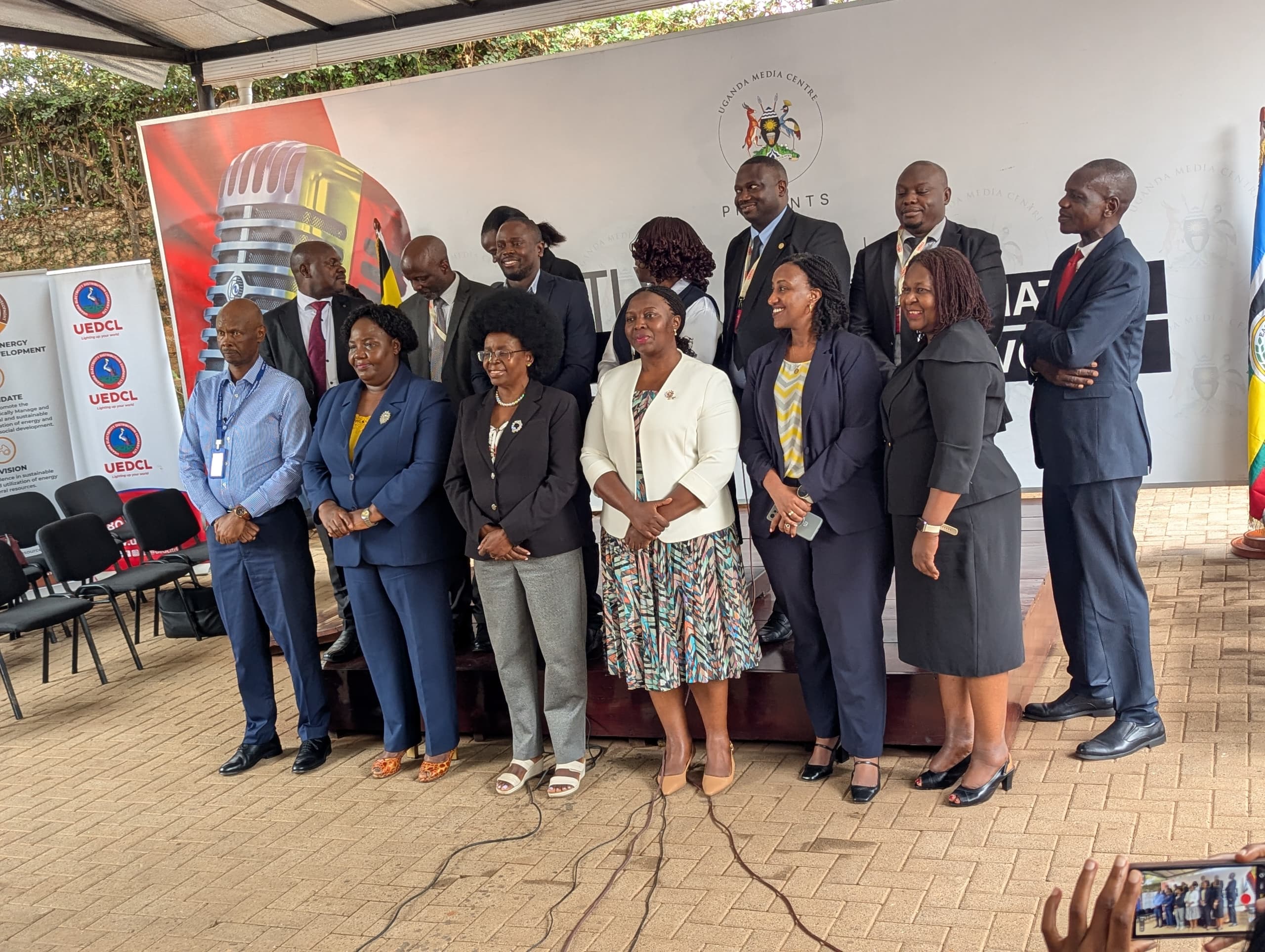
Uganda’s ongoing electricity network upgrade is expected to strengthen the country’s investment climate and support long-term economic growth, even as businesses and households continue to grapple with intermittent power outages that government says will end by August 8.
The Minister of Energy and Mineral Development, Monica Musenero Masanza, apologized to Ugandans for the prolonged electricity disruptions affecting Kampala Metropolitan Area and several parts of the country, describing the inconveniences as a necessary consequence of one of the largest power infrastructure improvement projects undertaken in recent years.


Speaking during a joint media briefing with officials from the Uganda Electricity Distribution Company Limited (UEDCL), Dr. Musenero assured the public that the outages are temporary and are intended to pave the way for a stronger and more reliable electricity system capable of meeting Uganda’s rising energy demand.
She explained that rapid urbanization, expansion of industrial parks, commercial growth and increasing household electricity connections have placed enormous pressure on the country’s aging transmission and distribution infrastructure, resulting in frequent outages and unstable voltage.
The minister said Uganda’s electricity demand continues to rise alongside government efforts to expand access to affordable power. UEDCL currently serves about 2.7 million customers, while national electricity access has reached 62 percent.
Since January this year, the utility has connected approximately 76,000 new customers, but nearly 500,000 applications remain pending due to infrastructure limitations. Government expects the backlog to be cleared within the next six months once the ongoing network upgrades are completed.
At the centre of the upgrades is the Kampala Metropolitan Transmission System Improvement Project, financed by the Japan International Cooperation Agency, which is now 91 percent complete.
The remaining phase involves integrating newly constructed substations and transmission lines into the national grid, a process that requires planned power shutdowns to ensure the safety of engineers and technical teams.
The project includes the construction of new substations at Maya, Bureeba and Mukono, upgrading existing substations including Mutundwe, reinforcing critical 132-kilovolt transmission lines and deploying a mobile substation at Namungona to stabilize electricity supply during the transition.
Energy experts say such investments are critical as Uganda positions itself to attract more manufacturing industries, data centres, agro-processing facilities and other energy-intensive investments that require a dependable electricity supply.
Government has consistently identified reliable electricity as one of the key pillars for industrialization under the country’s long-term development agenda.
Beyond increasing demand, the minister said vandalism of electricity infrastructure continues to undermine service delivery and increase maintenance costs.
Recent incidents have been reported in Mukono, Namayiba and Dokolo, where criminals targeted transmission towers, transformers, underground cables and power lines, disrupting electricity supply and forcing costly repairs.
She appealed to communities to protect public infrastructure by reporting vandals, noting that such acts ultimately delay service improvements and increase operational costs that affect consumers and businesses alike.
Routine maintenance and overloaded transmission lines have also contributed to the current outages.
UEDCL Managing Director Eng. Joselynne Rwabwogo Rwakakooko said the final phase of the Kampala transmission upgrade will temporarily affect areas including Masanafu, Kinonya, Lugala, Lusaze, Busega, Matete and neighbouring communities until August 8.
She encouraged customers experiencing faults to use the utility’s official toll-free customer care channels and cautioned the public against paying money to individuals claiming they can expedite electricity connections or meter installations.
Rwabwogo revealed that government has secured a fresh stock of electricity meters and transformers that will significantly improve service delivery.
The new equipment will facilitate faster customer connections, replacement of faulty transformers and meters, and installation of more than 500 additional transformers to improve voltage in underserved areas.
The ongoing investment in Uganda’s electricity infrastructure comes at a time when government is intensifying efforts to industrialize the economy, promote value addition and attract foreign direct investment.
A more stable electricity network is expected to reduce production losses caused by outages, lower operational costs for manufacturers and improve the competitiveness of Ugandan businesses.
While the temporary power interruptions have affected households, traders and industries, government maintains that the short-term inconvenience will deliver long-term economic benefits through a modernized electricity grid capable of supporting Uganda’s growing economy and expanding industrial base.











 English