
















Allegations against Nwoya Resident District Commissioner Christopher Omara have reignited debate about accountability, abuse of office, and the growing crisis of land governance in northern Uganda, with residents and local leaders accusing the presidential representative of interfering in land disputes, frustrating justice processes, and mismanaging public office.
At the center of the controversy is a disputed piece of land measuring hundreds of acres in Wii-Anaka, where Omara is accused of benefiting from contested land allocations while allegedly using his office to frustrate investigations and legal redress sought by claimants.


The accusations, though yet to be independently verified, paint a troubling picture of the intersection between political authority, land conflicts, and weak institutional oversight in post-war northern Uganda, where land ownership remains one of the most sensitive and explosive issues.
The most serious accusations involve land said to belong to businessman and claimant Christopher Karama Oola. According to complaints filed by Karama and individuals familiar with the dispute, sections of the contested land were allegedly allocated to investors and other interests despite ongoing ownership disagreements.
Sources close to the matter allege that about 500 acres were informally earmarked for Omara as part of arrangements linked to the land dispute, claims that the RDC has not publicly responded to.
The earmarked portion of land is reportedly leased to a Russian investor operating under the name Avagrow Farm, said to have interests in commercial farming in the area.
Residents claim tensions escalated when individuals said to be the real owners attempted to access the land and were allegedly attacked by unknown groups.
“They beat up these people while they had gone to their land to pay workers. They robbed them of their money and injured them seriously,” one resident alleged on condition of anonymity due to fear of reprisals.
The allegations have heightened concerns about the use of force and intimidation in land conflicts, a recurring problem in northern Uganda where commercial agriculture projects often collide with customary land ownership systems.
Petition to ODPP Raised Questions About Obstruction of Justice
On October 20, 2025, Karama formally petitioned the regional office of the Office of the Director of Public Prosecutions in Gulu City, accusing authorities of frustrating the prosecution of an aggravated robbery case connected to the land dispute.
The case, registered as CRB 519/2025 at Nwoya Central Police Station, reportedly involved suspects identified as ODIYA Anthony, Lobowire Denis, and others.
In his petition, Karama complained that despite investigations and arrests having been made, the case file had allegedly not been forwarded to court in time for the scheduled hearing.
“This delay not only violates my right to a speedy trial but also undermines public confidence in the criminal justice system and potentially jeopardizes the successful prosecution of this serious crime,” Karama wrote in the complaint.
He further warned that failure to act would compel him to escalate the matter to higher authorities, including the Inspectorate of Government and the Uganda Law Council.
The complaint raises broader concerns about accountability within the justice system, particularly in politically sensitive disputes involving powerful local officials.
Legal analysts say delays in handling criminal case files often create suspicion among communities already struggling with low confidence in public institutions.
“In many districts, people believe justice depends on who has political connections,” said a legal practitioner familiar with land litigation in the Acholi sub-region. “When cases delay without clear explanation, communities interpret that as interference.”
Wider Claims of Abuse of Office
Beyond the Wii-Anaka dispute, additional allegations have emerged from Kokigoma, where residents accuse local leaders and officials of irregularly redistributing land to new settlers.
One landlord identified as Livingston reportedly lost control over portions of his land after local authorities allegedly facilitated allocations to third parties.
Residents claim the LC3 chairperson collected land-related fees from settlers and that kickbacks were allegedly shared among officials, including the RDC. No documentary evidence supporting the claims has yet been publicly produced.
The allegations contributed to growing tensions within the district council, where some councillors reportedly attempted to push for a vote of no confidence against Omara, the RDC.
According to district sources, the effort failed amid political divisions and resistance from individuals believed to be aligned with him.
Several councillors accused the RDC of running the office in a manner that favored individuals willing to “go through the backdoor” to secure decisions in disputes and administrative matters.
Others accused him of having strained relations with district technical staff and elected leaders, alleging frequent conflicts and public accusations of corruption against officials who allegedly refused to cooperate with him.
The accusations reflect a deeper institutional problem often seen in local governments, where RDCs, district chairpersons, technocrats, and security officials operate in overlapping spheres of authority that frequently generate conflict.
Tensions With Security and Political Leaders
Sources in Nwoya further claim Omara has had repeated disagreements with security personnel and ruling party leaders in the district.
Among those reportedly targeted were District Internal Security Officer Otim and former District Police Commander Anyama, both of whom allegedly faced serious blackmail from the RDC during their service in the district but were promoted upon transfer due to their commendable work.
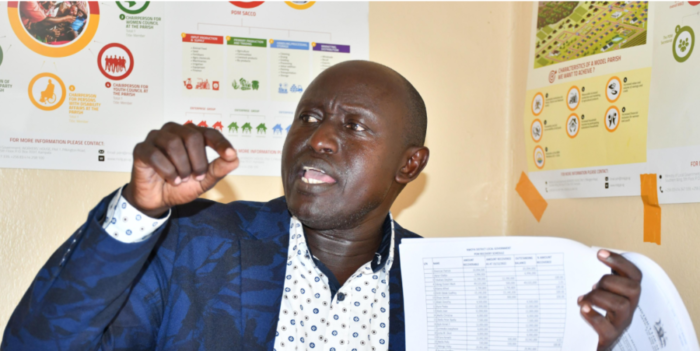
Omara has previously defended himself by claiming he became unpopular after ordering action against parish chiefs accused of mishandling funds under the Parish Development Model program.
The RDC has maintained that he is the victim of coordinated political witch-hunts orchestrated by individuals threatened by his anti-corruption stance.
That defense mirrors a common pattern in Uganda’s local governance politics, where officials facing accusations often counter that they are being punished for fighting entrenched interests.
The difficulty, analysts say, lies in separating genuine anti-corruption efforts from political rivalry.
Questions Over Functionality of the RDC Office
The controversy has also exposed concerns about the state of the Office of the President in Nwoya District.
Sources allege that Omara rarely delegates responsibilities to deputies and assistants, creating operational paralysis within the office.
His deputy RDC, identified as Ezama Ham, allegedly became inactive and later deserted the office after reportedly being sidelined and denied responsibilities.
Additional claims suggest the office suffered administrative breakdowns, including disputes involving official drivers, secretarial staff, and maintenance of government vehicles.
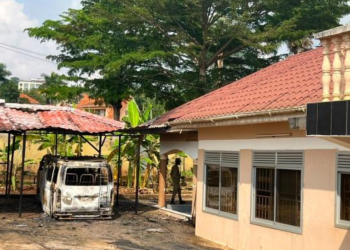
Residents allege that the RDC’s official vehicle eventually became non-functional and was later towed back to headquarters after remaining parked for a long period at Anaka Hospital, where its engine was reportedly stolen.
Some locals claim Omara frequently relies on boda bodas or lifts from district officials to attend official functions.
One resident described the situation as “an embarrassment to the image of the Office of the President.”
The allegations have fueled calls for inspection and possible intervention from higher authorities within government.
By press time, there had been no official communication from the Office of the President confirming whether investigations or administrative reviews had been initiated regarding operations in Nwoya.
Northern Uganda’s Land Crisis
The accusations against Omara come against the backdrop of a wider land governance crisis in northern Uganda.
Years after the end of the Lord’s Resistance Army insurgency, land disputes remain widespread across the Acholi sub-region as returning communities, investors, local elites, and government interests compete over ownership and control.
Customary land tenure systems, which dominate the region, often lack formal documentation, making communities vulnerable to manipulation and dispossession.
Human rights organizations and land rights activists have repeatedly warned that politically connected individuals sometimes exploit institutional weaknesses to acquire land or influence dispute resolution processes.
In many cases, RDCs wield enormous influence because they coordinate security operations, supervise government programs, and often mediate local conflicts on behalf of the central government.
Critics argue that this concentration of influence without strong oversight mechanisms creates opportunities for abuse.
Accountability Must Go Beyond Allegations
The allegations surrounding the Nwoya RDC reveal a larger governance challenge facing Uganda’s local administration structure.
Whether every accusation against Omara is ultimately proven or not, the volume and consistency of complaints from residents, political leaders, and local stakeholders point to a serious trust deficit between citizens and public institutions.
The most concerning aspect is not merely the alleged corruption or land grabbing itself, but the perception that justice processes can be manipulated through political influence.
When citizens believe that criminal case files can disappear, court processes can be delayed, or land disputes can be decided through informal networks rather than legal systems, public confidence in the rule of law erodes rapidly.
The situation also exposes structural weaknesses within the RDC system.
Resident District Commissioners are presidential appointees with significant political and administrative power at the district level. However, mechanisms for local accountability remain limited because RDCs are not directly elected by communities.
This can create tension between appointed officials and elected leaders, especially in districts where land and investment disputes carry high economic stakes.
For government, the challenge now is not simply whether to defend or condemn one RDC. The bigger issue is whether institutions can demonstrate impartiality, transparency, and accountability when allegations emerge against powerful state representatives.
If investigations are ignored or perceived as selective, mistrust in public institutions will deepen.
But if credible inquiries are conducted openly and fairly, regardless of political connections, authorities could begin restoring confidence in governance systems that many citizens increasingly view with suspicion.
Ultimately, accountability is not only about punishing wrongdoing. It is about ensuring that public office serves citizens rather than personal interests, especially in regions where land remains both a livelihood and a source of identity.
ENDS.




 English