
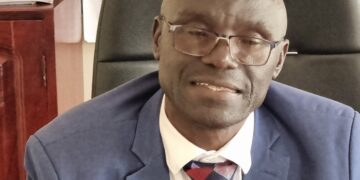






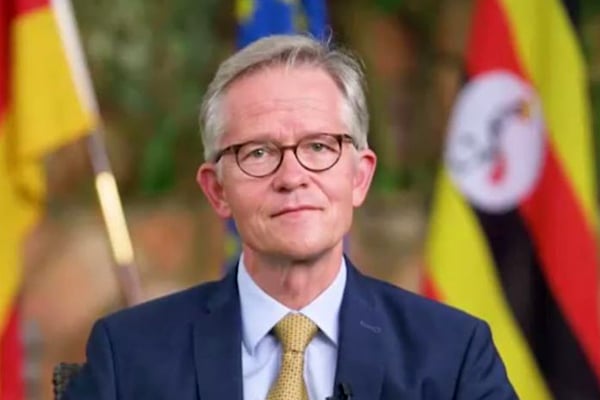
Kampala, Uganda — The Uganda People’s Defence Forces (UPDF) has leveled serious accusations against the German Ambassador to Uganda, Mathias Schauer, claiming he is involved in “illegal and clandestine activities” aimed at destabilizing the Ugandan government.
In a strongly worded statement released on Friday via X (formerly Twitter) and posted on the official UPDF website, Colonel Chris Magezi, the Acting Director of Defence Public Information, alleged that security agencies have been closely monitoring “emerging rebel groups” in the country, with foreign involvement suspected.

Magezi revealed that, over the past few months, Ugandan security and intelligence agencies have arrested and interrogated several suspects linked to armed rebellion plots, plans to bomb public places, and economic sabotage, particularly the vandalism of electricity infrastructure.
He listed Wakiso, Mukono, Kayunga, Luweero, Nakaseke, Kiboga, Nakasongola, Mityana, Mubende, Mpigi, and the greater Masaka region as the most affected areas.
The most incendiary part of the statement accuses Ambassador Schauer of engaging in activities that violate the 1961 Vienna Convention on Diplomatic Relations, which governs the conduct of diplomats worldwide.
“We are particularly concerned about the illegal and clandestine activities of the German Ambassador in Uganda, His Excellency Mathias Schauer,” the statement reads. “The intelligence services are aware of his clearly undiplomatic practices… which go against the spirit of the 1961 Vienna Diplomatic Conventions.”
The German Embassy has not issued a public response, and attempts by journalists to reach Ambassador Schauer were unsuccessful.
His last known public appearance was at a high-profile meeting between EU diplomats and General Salim Saleh, President Museveni’s brother, in Gulu.
A video from the event showing a heated exchange between Schauer and journalist Andrew Mwenda circulated widely on Friday, heightening public interest and speculation.
The diplomats at the meeting reportedly raised concerns about alleged torture and the conduct of Uganda’s Chief of Defence Forces, General Muhoozi Kainerugaba, who is also the president’s son.
In the video, General Saleh issued an apology on Muhoozi’s behalf.
Foreign Interference and Opposition Links
Colonel Magezi emphasized that the Ugandan government is addressing the matter through diplomatic channels. He warned that any attempt to interfere in Uganda’s internal affairs would be met with decisive action.
“The Uganda People’s Defence Forces and the Inter-Agency Security Committee strongly condemn foreign influence meddling in Uganda’s internal affairs,” he said, urging young people to avoid being manipulated by “enemy political actors.”
The UPDF also alleged that funding and mobilization of subversive groups trace back to some European diplomatic missions operating in Kampala.
Focus on NUP
In a direct accusation, Magezi linked the National Unity Platform (NUP), Uganda’s main opposition party, to rebel activities.
“Some of the arrested suspects previously passed off as opposition political party activists, especially of the National Unity Platform. Many have been charged and remanded,” Magezi noted.
He warned that “local traitors” collaborating with foreign entities would be dealt with in accordance with Ugandan law.
Muhoozi’s Warning to Parents
Separately, General Muhoozi Kainerugaba took to his X account to caution parents against letting their children associate with the NUP, which he implied is engaged in more than political activities.
“Intelligence reports indicate that NUP is not merely a political party, but is also involved in activities that raise concerns related to terrorism,” Muhoozi wrote.
“Kabobi is a rebel,” he added, using a derogatory reference to NUP leader Robert Kyagulanyi, also known as Bobi Wine.
Escalating Tensions Ahead of Elections
The UPDF says its Inter-Agency Security Committee—comprising police, intelligence, and prison services—continues to monitor and dismantle “terrorist and subversive cells” allegedly operating in urban ghettos, especially around Kampala.
In their most recent meeting, the committee reportedly resolved to take “firm action” against individuals and groups allegedly planning to disrupt the 2026 general elections.










 English