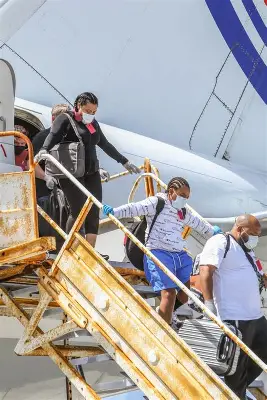
Eight asylum seekers originating from African countries but previously residing in the United States arrived at Entebbe International Airport on Friday, marking the first official transfer under a controversial migration cooperation agreement between Uganda and the U.S.
The group, cleared for relocation by a U.S. immigration court, does not hold citizenship in either Uganda or the United States.
Their arrival signals the operational rollout of a bilateral arrangement signed in July 2025 that allows Washington to transfer certain asylum applicants to Uganda for further processing.
This development comes just a day after another group of 12 deportees landed in Uganda via a privately chartered flight, intensifying scrutiny over the arrangement.
Legal and human rights bodies have since raised alarm, questioning both the legality and humanitarian implications of the transfers.
The Uganda Law Society, working alongside the East Africa Law Society, has petitioned the High Court seeking to halt the implementation of the agreement.
In a strongly worded statement, the legal bodies described the transfers as degrading and inconsistent with international human rights standards, arguing that they risk commodifying vulnerable individuals.
Ugandan authorities, however, have defended the move. The Ministry of Foreign Affairs confirmed the arrivals, noting that the individuals are unwilling or unable to return to their countries of origin.
Officials maintain that Uganda’s role aligns with its longstanding reputation for hosting displaced populations.
Permanent Secretary Bagiire Vincent Waiswa said the arrangement reflects Uganda’s commitment to offering refuge to those in need, while State Minister for Foreign Affairs Henry Okello Oryem framed the initiative as a broader African responsibility to support displaced persons rejected elsewhere.
Officials from the U.S. Embassy in Kampala confirmed the transfers were conducted in coordination with Ugandan authorities, though they declined to disclose details of individual cases, citing confidentiality.
The agreement, formally titled the “Cooperation in the Examination of Protection Requests,” allows the United States to redirect certain asylum seekers to Uganda for Refugee Status Determination.
While Uganda retains discretion to accept or reject individual cases, the deal excludes minors traveling alone and individuals with criminal records.
It also reaffirms adherence to the principle of non-refoulement, a cornerstone of international refugee protection that prohibits returning individuals to countries where they may face persecution or harm.
This principle is embedded in global legal frameworks such as the United Nations High Commissioner for Refugees conventions and is domesticated under Uganda’s Refugees Act of 2006.
However, critics argue that Uganda’s already stretched refugee system may struggle to absorb additional caseloads. The country currently hosts close to two million refugees, primarily from the Democratic Republic of Congo, South Sudan, Sudan, and Eritrea.
Recent funding shortfalls have further strained operations, with humanitarian agencies reporting reduced capacity to process new claims and provide essential services.
Legal experts warn that the added burden could compromise timely and fair hearings for asylum seekers.
The High Court petition now sets the stage for a legal showdown that could determine the future of the agreement.
At the heart of the case lies a difficult balance: Uganda’s global standing as a welcoming refuge versus the practical limits of its resources and institutional capacity.





























 English