







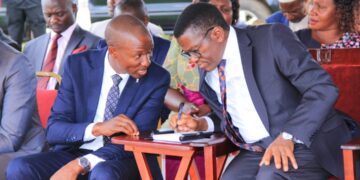






The political contest for the Masaka City Woman Member of Parliament seat has taken a new twist after National Unity Platform candidate Rose Nalubowa met President Yoweri Kaguta Museveni in an effort to reclaim the parliamentary victory she believes was taken from her following a controversial vote recount that favored National Resistance Movement candidate Justine Nameere.
Nalubowa reportedly met the President at the Masaka State Lodge during his recent visit to Masaka City.


The meeting also involved Nameere and was intended to allow both candidates to present their sides of the dispute surrounding the January 2026 election for the Masaka City Woman MP seat.
Sources familiar with the meeting say the President later constituted a special team from State House to investigate the matter further.
According to the same sources, the team conducted interviews with polling officials and agents from both sides and recorded statements regarding the disputed election results.
The investigators reportedly focused particularly on polling stations where the results had been contested, especially those where Nameere had registered strong support.
The exercise is said to have been aimed at establishing whether irregularities occurred during the voting and subsequent recount. The dispute stems from the Masaka City Woman MP election held on January 15, 2026.
Nalubowa, who contested under the National Unity Platform ticket, was initially declared the winner after securing 25,443 votes against Nameere’s 20,324 votes under the National Resistance Movement.
The declaration was later challenged in court, leading to a recount supervised by Masaka Chief Magistrate Albert Asiimwe.
Following the recount, the results dramatically changed and Nameere was declared the winner with 25,502 votes while Nalubowa’s tally dropped to 23,176 votes.
The recount itself sparked controversy after irregularities were reported during the process. Among the issues raised was the discovery of a ballot box without a security seal, which was subsequently excluded from the recount exercise.
Another polling station, Kimwanyi Primary School, had its results disregarded after the ballot box reportedly contained ninety seven votes all cast in favor of Nameere.
Nalubowa has since taken the dispute to the High Court of Uganda in Masaka where she filed an election petition challenging the legality of the recount.
The petition lists Nameere, the Masaka City Returning Officer and the Electoral Commission of Uganda as respondents.
Nalubowa recently revealed that her lawyers attempted to serve Nameere with formal notice of the petition but she allegedly declined to receive it.
In a public notice published in national newspapers including the New Vision and the Daily Monitor, Nalubowa said the law allowed alternative service through publication after the respondent declined to accept the notice directly.
The publication confirmed that the petition had already been filed before the High Court and that the matter would now be determined through the judicial process.
The dispute has also exposed tensions within the local leadership of the ruling party in Masaka City. Reports indicate that Nameere and some members of the city’s NRM structure have recently disagreed on how the matter should be handled.
Rogers Bulegeya, who heads the party structure in the city, has repeatedly insisted that the issue should be left to competent courts of law to determine the rightful winner rather than being settled through political intervention.
Nalubowa’s own political background adds another layer to the unfolding drama.
For many years she was known as a loyal member of the NRM before eventually crossing to the opposition National Unity Platform led by Robert Kyagulanyi Ssentamu.
Her decision to join the NUP came at a time when the opposition party had gained significant popularity in the greater Masaka region.
Despite campaigning on a message of political change, Nalubowa notably avoided direct personal attacks on President Museveni during the campaign period, a strategy that political observers say may have helped keep channels of dialogue open between her and the ruling establishment.
Sources within Masaka also claim that Nalubowa enjoys strong support from influential leaders within the Catholic Church who have been closely following the dispute and reportedly encouraged efforts toward dialogue.
Interestingly, the leadership of the National Unity Platform headquartered at Kavule has remained publicly silent regarding Nalubowa’s decision to meet President Museveni while the matter is before court.
Some political analysts, however, believe that her decision to engage the President could be seen as a pragmatic step aimed at ensuring that the concerns surrounding the disputed election receive national attention.
As the legal and political processes continue simultaneously, many residents of Masaka City are now closely watching both the State House investigation and the proceedings before the High Court.
The final decision from the judiciary will ultimately determine who legitimately won the Masaka City Woman MP seat and whether the recount process followed the law.
From a political perspective, Nalubowa’s chances largely depend on whether the High Court finds serious procedural irregularities in the recount exercise.
If the court determines that the recount violated electoral procedures or improperly handled disputed ballot boxes, the original declaration that gave Nalubowa victory could be reinstated or the election nullified.
Her strong grassroots support in Masaka and the sympathy she has attracted from opposition supporters may also strengthen her political position.
On the other hand, Nameere’s case rests heavily on the fact that the recount was conducted under court supervision and resulted in her being officially declared the winner.
Courts often give weight to such processes unless clear evidence of malpractice is presented.
Her position is therefore strengthened by the formal outcome of the recount and the institutional support she enjoys within the ruling party.
The investigations reportedly initiated by President Museveni may not carry direct legal authority to overturn election results, but their findings could influence public opinion and possibly shape political negotiations around the dispute.
Ultimately, however, the decisive ruling will come from the High Court, whose judgment will determine whether the recount result stands or whether Nalubowa’s challenge succeeds.
For now, the Masaka City Woman MP race remains one of the most closely watched political disputes in the country.



 English