

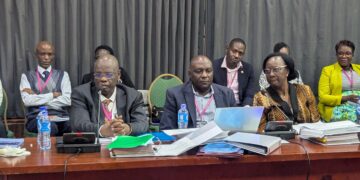
















The Mukono High Court has rejected audio and video recordings made by two journalists during the declaration of the Mukono District LC5 election results, ruling that the petitioner failed to properly account for how the electronic evidence was recorded, transferred and preserved.
Justice Phillip Mwaka excluded recordings presented by Ronald Kalumba of BBS TV and Isaac Kafeero of Baba TV, saying the evidence did not sufficiently establish the chain of custody required to authenticate the recordings.


The ruling came during the hearing of a petition filed by Johnson Muyanja Ssenyonga, who is challenging the election of Francis Lukooya Mukoome as Mukono District LC5 chairperson.
Ssenyonga alleges that he was initially declared the winner of the election held on January 22, 2026, before the results were subsequently altered in favour of Lukooya.
The petitioner also alleges that results were falsified or swapped and that voters were disenfranchised at several polling stations.
Kalumba, who was listed among the petitioner’s witnesses, stated in his affidavit that he was at the Electoral Commission offices in Mukono on January 23, 2026, when Returning Officer Emily Amongin announced the election results.
He said he recorded the declaration and attached a flash drive containing the recording to his affidavit.
Justice Mwaka, however, questioned the evidential trail of the recording, noting that Kalumba had not identified the device he used to make the recording or explained how the recording was transferred from that device to the flash drive submitted to court.
Following the court’s concerns, lawyers for Ssenyonga agreed that Kalumba’s evidence be expunged from the record.
The court similarly rejected a recording made by Kafeero.
Kafeero said he recorded the Returning Officer’s voice during the declaration using a camera. However, his affidavit did not explain how the recording was extracted from the camera and transferred to the device presented to court.
Justice Mwaka agreed with the respondents that the unexplained transfer constituted an important gap in the evidential chain.
The judge held that the omission raised questions about the authenticity and integrity of the recording, making it inadmissible.
The rejection of the recordings removes two pieces of evidence that the petitioner intended to use to support his account of what happened during the declaration of the results.
Disputed Declaration
Ssenyonga’s lawyers, led by Charles Wamukota and John Nalela, told court that their client was one of the candidates who contested the January 22 LC5 election.
Nalela said Ssenyonga was publicly declared the winner by Returning Officer Amongin on January 23, although he was not issued a declaration form at the time.
The petitioner alleges that the results were later altered, falsified and swapped, resulting in Lukooya being declared the winner.
The petition further cites alleged disenfranchisement of voters at Kiwafu Tea Estate, Masujju Mosque, Mpunge Primary School and Buwuja Faith Nursery School.
Lukooya Denies Alteration
Lukooya, through his lawyer Ivan Amanya, rejected the allegations.
Amanya told court that his client contested the election on the NRM ticket and was declared the winner on January 23 after the results from the polling stations had been tallied.
Lukooya was subsequently gazetted on April 14 as Mukono District chairperson.
His lawyers maintain that the election was conducted freely, fairly and transparently and in accordance with the law. They therefore indicated that they had no intention of cross-examining the witnesses presented by the petitioner.
Amanya further submitted that the petitioner’s allegations were not supported by the official declaration forms and returned results.
Electoral Commission Defends Results
The Electoral Commission, represented by lawyer Mukasa Ssendyona, also defended the outcome.
Ssendyona told court that the Commission is constitutionally responsible for organising and conducting elections and that Lukooya was declared the winner after obtaining the highest number of votes following the tallying of returns from all polling stations.
He maintained that the declared winner was the candidate whose name appeared on the official declaration forms.
The Commission’s position is that the final result was based on the complete tally of returns submitted from the polling stations.
Court Rejects Supplementary Affidavit Seeking Forensic Examination
The dispute also extended to the authenticity of election documents.
The petitioner’s lawyers filed supplementary material seeking a forensic examination of 22 declaration of results forms.
Wamukota told court that some copies of the forms obtained by the petitioner contain signatures that allegedly differ from those appearing on certified copies held by the Electoral Commission.
The petitioner took the forms to Ssebuwufu, a police handwriting expert, for examination to establish the authenticity and authorship of signatures attributed to polling agents and presiding officers.
The petitioner’s lawyers argued that the forensic examination report could assist court in determining whether the documents relied upon by the parties are authentic and whether there was any alteration of the election results.
The defence, however, raised concerns about the timing of the supplementary evidence. The lawyers also argued that they had already indicated that they would not cross-examine some witnesses, but that admitting additional affidavits could require them to obtain their own experts and conduct a fresh examination of the documents.
The judge agreed with the defence that allowing the supplementary affidavit at this stage could affect the progress of the trial.
The court observed that such a process could prolong the proceedings.
Justice Mwaka subsequently adjourned the hearing to Wednesday, when the Electoral Commission is expected to present its witnesses for cross-examination.
The Commission is expected to call nine witnesses as the hearing continues.
ENDS.






 English