


















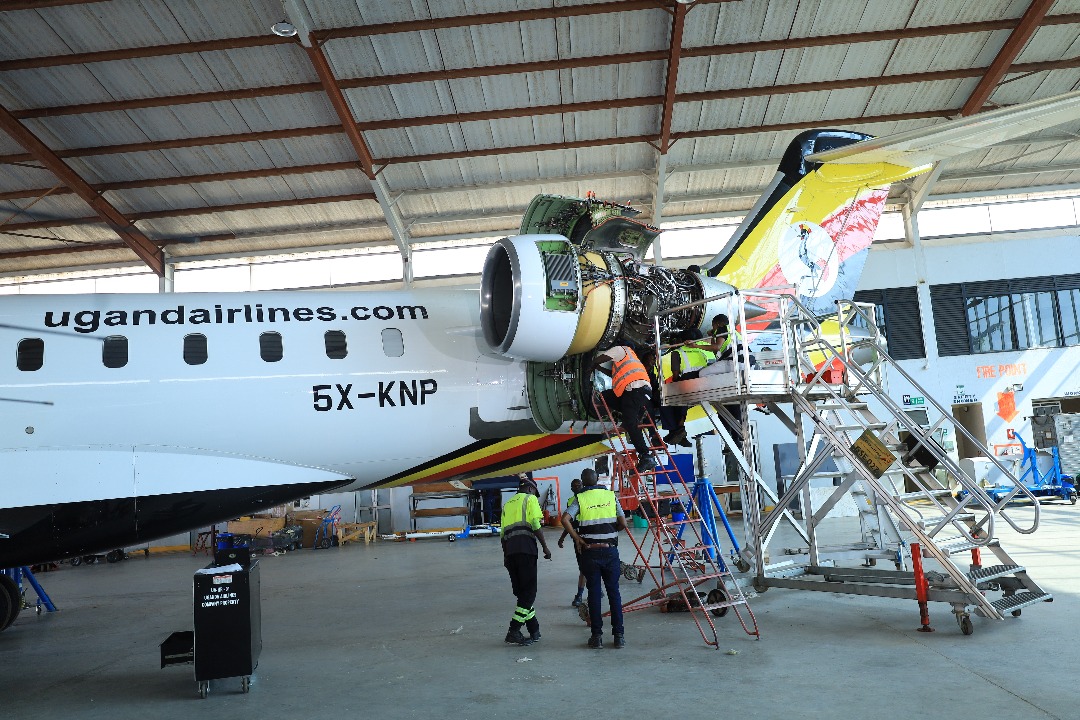
Uganda Airlines has successfully carried out its first aircraft engine replacement at Entebbe International Airport, a landmark achievement that highlights the growing technical capacity of the national carrier.
The task involved removing and installing a new left engine on one of the airline’s Bombardier CRJ900 jets, a process that typically takes several weeks to complete.


Previously, such heavy maintenance work was outsourced to facilities in South Africa or the Netherlands—an arrangement that cost the company no less than 100,000 US dollars (about UGX 400 million) each time.
The breakthrough was executed by in-house engineers under the airline’s Approved Maintenance Organisation (AMO), which currently employs over 40 specialists trained from institutions such as Soroti Flying School and Makerere University.
While the facility has mainly been handling light maintenance tasks like tire changes and minor repairs, this engine swap marks its first major assignment.
According to the airline’s head of engineering and maintenance, Peter Emuge, the AMO is working towards building capacity to undertake heavy or base maintenance within the next three years.
Such work includes detailed structural inspections, full engine overhauls, and interior reconfigurations—crucial for keeping aircraft compliant with aviation safety regulations and extending their service life.
Uganda Airlines officials also clarified that despite ongoing supply chain challenges, there are no plans to phase out the CRJ fleet. Emuge explained that the global shortage of aircraft parts—triggered by reduced production during the COVID-19 slowdown and compounded by stockists hoarding spares—has created difficulties across the industry.
“Maintenance demand is rising because airlines are flying more frequently and covering longer distances. At the same time, supply of spare parts has not recovered to match post-pandemic demand,” Emuge said.
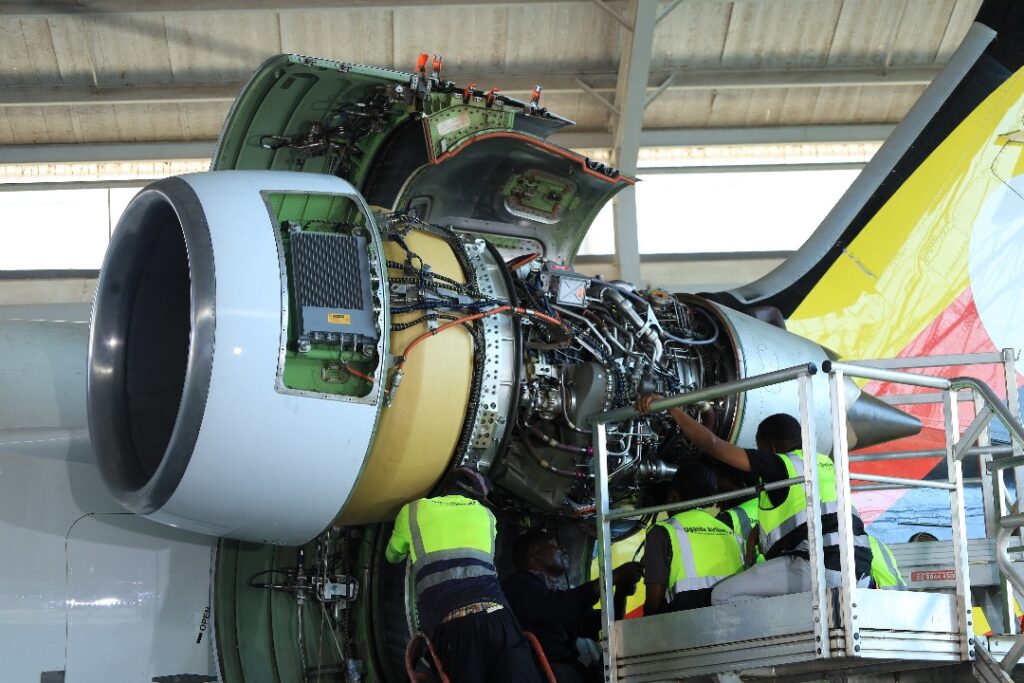
To counter these disruptions, Uganda Airlines has begun securing components well in advance through long-term arrangements with suppliers.
The recently installed engine on CRJ 5X-KNP, for instance, had been ordered long before the old one became due for replacement.
The situation is not unique to Uganda. AerFin CEO Simon Goodson notes that major international carriers, including British Airways and Pakistan International Airlines, have also been forced to ground aircraft due to shortages of serviceable engines and spare parts.
Uganda Airlines CEO Jennifer Bamuturaki praised the foresight that allowed the airline to keep its fleet operational.
“Some of our regional neighbors have aircraft grounded because they lack engines. For us, because we planned ahead, the government was able to secure one in time, and that has kept our operations intact,” she said.
The milestone is seen as a significant step not only in reducing operational costs but also in positioning Entebbe as a future maintenance hub for regional airlines across Africa.










 English