











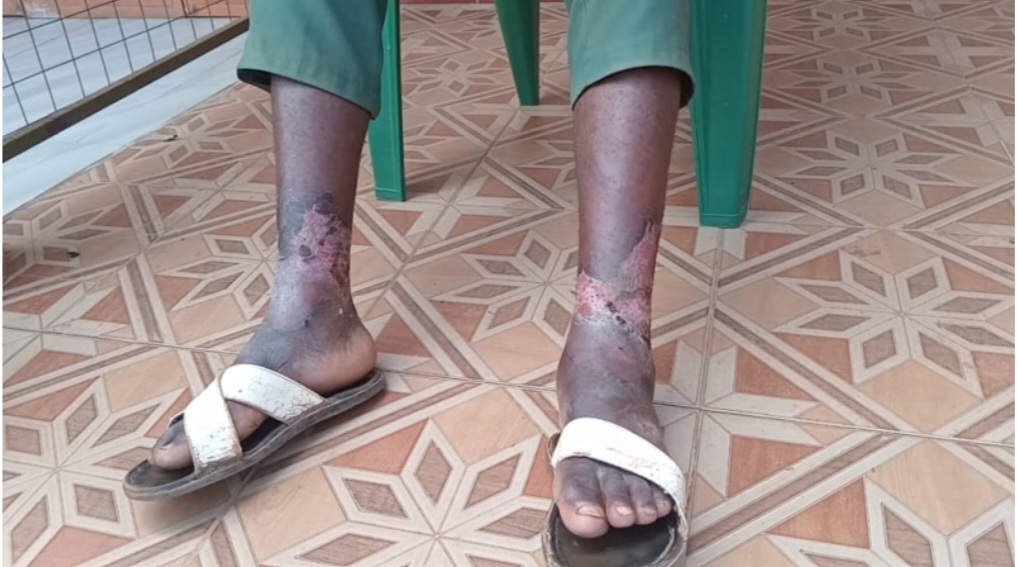
In a small home in Namabasa, on the outskirts of Mbale City, 38-year-old Michael Rugumayo lies motionless, his legs wrapped in makeshift bandages. Beneath them are wounds so severe, he says, “the flesh was burnt to the bone.”
Once the sole provider for a family of six, Rugumayo is now unable to walk, work or fend for his wife and four children. Hunger has crept into the household, replacing the hope that brought him here just weeks ago.


“I am dying of pain,” he says quietly. “My children are looking at me, and I have nothing to give them.”
Rugumayo had travelled from Fort Portal to Mbale in search of opportunity. Like many Ugandans drawn by the promise of industrial jobs, he found work at one of the factories inside the vast Sino Park industrial complex.
It was meant to be the beginning of a better life. Instead, it lasted only six days.
On March 5th, Rugumayo says he was assigned by his supervisor, Joseph Kutosi, to work near a tank filled with boiling water mixed with industrial chemicals. He had no protective gear.
Moments later, he slipped. In an instant, he was submerged in what he describes as “liquid fire.”
According to Rugumayo, the lack of safety equipment is common practice among workers in the industrial park.
“There was no protection,” he recalls. “We just worked like that.”
What followed the accident, he says, was confusion and neglect. He received basic first aid before being rushed to a nearby clinic. But treatment soon stalled when medical bills began to accumulate.
When the clinic demanded a balance of 20,000 shillings, he says, payments from the factory stopped.
With no income and no support, he discontinued treatment altogether.
His supervisor, Joseph Kutosi, disputes parts of Rugumayo’s account. He insists the company did not abandon him, claiming instead that the injured worker chose to leave the clinic prematurely, worsening his condition.
Kutosi also pointed out that Rugumayo had only worked for six days, earning 6,000 shillings per day, suggesting the company had already gone beyond its obligation.
But to Rugumayo, such arguments miss the point. “When your legs are burnt like this, what matters is treatment,” he says.
When journalists first reached out to officials at Mbale Sino Park, the response was stark: they denied Rugumayo had ever been their employee.
They claimed he had used a fake identification card to access the factory.
However, as scrutiny intensified, the narrative shifted. Management later acknowledged that Rugumayo had indeed worked at the facility and offered him 200,000 shillings toward his treatment.
For a man facing extensive medical care and unable to earn a living, the amount barely scratches the surface.
“It is too little,” Rugumayo says. “I need full compensation.”
Back in Namabasa, the consequences of the accident stretch far beyond physical pain.
Rugumayo’s wife now shoulders the burden of caring for both her injured husband and their four children, with no stable income. Meals are uncertain. Medical care remains out of reach.
The family’s situation reflects a broader vulnerability faced by many low-wage workers, particularly those employed in informal or loosely regulated industrial settings.
A spokesperson for Sino Park, identified as Kenneth, has since pledged that the company will ensure Rugumayo receives proper medical treatment and full compensation. He also suggested that Rugumayo could return to work once he recovers.
But for the injured worker, such assurances offer little comfort. After initial denial and delayed response, trust has already been eroded. “Promises are not treatment,” he says.
Rugumayo’s ordeal raises pressing concerns about workplace safety standards, enforcement of labour laws, and the responsibility of employers in Uganda’s growing industrial sector.
As industrial parks expand across the country, they bring jobs—but also risks, especially where safety protocols are weak or inconsistently applied.
For workers like Rugumayo, the cost of those risks can be devastating.
For now, Rugumayo remains confined to his home, his future uncertain. His greatest wish is to return to Fort Portal, where he hopes his extended family can help him recover.
“I need to go back home,” he says. “Here, we cannot survive.”
As he waits for compensation and proper medical care, one question continues to linger—not just for him, but for many workers in similar conditions:
Who takes responsibility when the pursuit of a livelihood turns into a fight for survival?






 English