





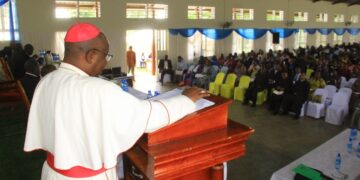












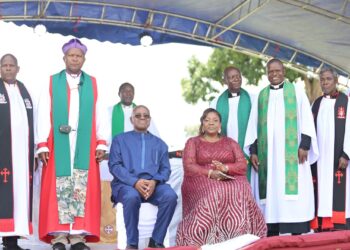
Preparations for the 2026 Uganda Martyrs Day celebrations have officially been flagged off at Uganda Christian University by Bishop Alfred Olwa, Chairperson of UCU Governing Council, marking the formal start of planning for the event.
UCU was entrusted by the House of Bishops to lead the 2026 Uganda Martyrs Day celebrations at the Anglican Shrine in Namugongo.

The celebrations, scheduled for June 3, 2026, will be coordinated under the leadership of Professor Rev. Dr. John Kitayimbwa, UCU’s Deputy Vice-Chancellor for Academic Affairs, who will serve as Chairperson of the Organising Committee. The commemorations will be guided by a theme drawn from Ephesians 2:14: “Christ our peace, breaking the walls, healing the nation.”
According to Dr. Kitayimbwa, the theme speaks directly to Uganda’s present realities, including economic hardship, youth unemployment, broken families, corruption, injustice, and a growing sense of anxiety and loneliness in society.
“Many Ugandans are carrying visible and invisible wounds,” he noted, adding that the message of Christ as peace comes at a time when the nation is yearning for reconciliation, hope, and renewal.
Every year, hundreds of thousands of pilgrims walk to Namugongo seeking forgiveness, healing, and spiritual renewal. The story of the Uganda Martyrs, he said, continues to challenge the nation.
The martyrs, young people from different backgrounds, stood firm in their loyalty to Christ, refusing to respond to hatred with hatred. Their witness, UCU leaders say, offers a powerful call to tear down walls of division between families, tribes, social classes, and political affiliations.
The organisers believe the theme is not merely a slogan but an invitation for Ugandans to allow Christ to reconcile them to God, to one another, and to a more peaceful and stable future.
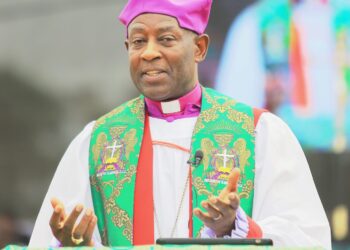
Bishop Alfred Olwa described UCU’s leadership role as both timely and appropriate. He explained that although dioceses traditionally rotate leadership of the celebrations, UCU is a provincial institution within Kampala Diocese, under the oversight of the Archbishop, who remains the chief celebrant.
“In many ways, this is not entirely new,” Bishop Olwa said, noting that the rota for leadership has come full circle. “UCU today stands shoulder to shoulder with dioceses like Kampala in terms of capacity and responsibility.”
One of the defining features of the 2026 celebrations will be the decision to transform Martyrs Day into a year-long spiritual journey rather than a single-day event. UCU, in partnership with the Church of Uganda, plans to roll out Bible teaching series across dioceses, parishes, UCU campuses, and colleges, all centred on the main theme.
Small discussion groups and fellowships will focus on forgiveness, reconciliation, integrity, and peacemaking, complemented by seasons of prayer and fasting for families, churches, and the nation.

Young people will be at the centre of the celebrations, with UCU students and other youth expected to serve as choristers, readers, drama performers, writers, journalists, media producers, and volunteers supporting pilgrims at Namugongo.
Another major focus will be preserving and telling the story of the Uganda Martyrs with depth and clarity. UCU will work with the Church of Uganda Archives, hosted at the university, the Namugongo Anglican Shrine, and other stakeholders to gather historical materials, photographs, and testimonies.
The plan includes exhibitions, short documentaries, and digital content aimed at reaching schools, parishes, community centres, and international audiences. Organisers say the goal is to ensure that a new generation not only knows that the martyrs died, but understands why they died and what their sacrifice means today.
UCU also plans to host public lectures and discussions on faith and integrity in public life, healing of memories, peaceful coexistence, and the pressures facing young people, exploring how Christ can anchor them in challenging times.
On June 3, 2026, the service at Namugongo will retain its national and international character, but with an intentional focus on spiritual depth. Plans include designated spaces for quiet prayer and reflection, counselling and spiritual support, clear Christ-centred preaching, and worship that reflects Uganda’s diversity while pointing believers to one Lord and one faith.
In anticipation of large crowds estimated at over one million pilgrims, UCU plans to construct modern sanitary facilities at the shrine. This follows concerns previously raised by the Minister of Health regarding sanitation challenges during past celebrations. The upgrades will be undertaken at a national scale, with funding from multiple sources.
Government has already indicated strong support, announcing that Shs1.2 billion will be allocated through the national budget. UCU will also contribute funds from its own budget, although exact figures are yet to be disclosed.
UCU Vice-Chancellor, Dr. Aaron Mushengyezi, described the opportunity to lead the 2026 celebrations as both a privilege and a responsibility. He noted that Uganda Martyrs Day is not only a national holiday but also an internationally acclaimed spiritual event that draws pilgrims from across Africa and beyond.
“These young people gave their lives for their faith and for a higher ideal,” Dr. Mushengyezi said. “They challenge us not only to die for something, but to live for a higher ideal.”
He reaffirmed UCU’s commitment to accountability and good stewardship, particularly where public and church funds are involved. Audits, post-event evaluations, and transparent reporting, he said, will be integral to the process to ensure continuous improvement for the good of the nation.




 English