










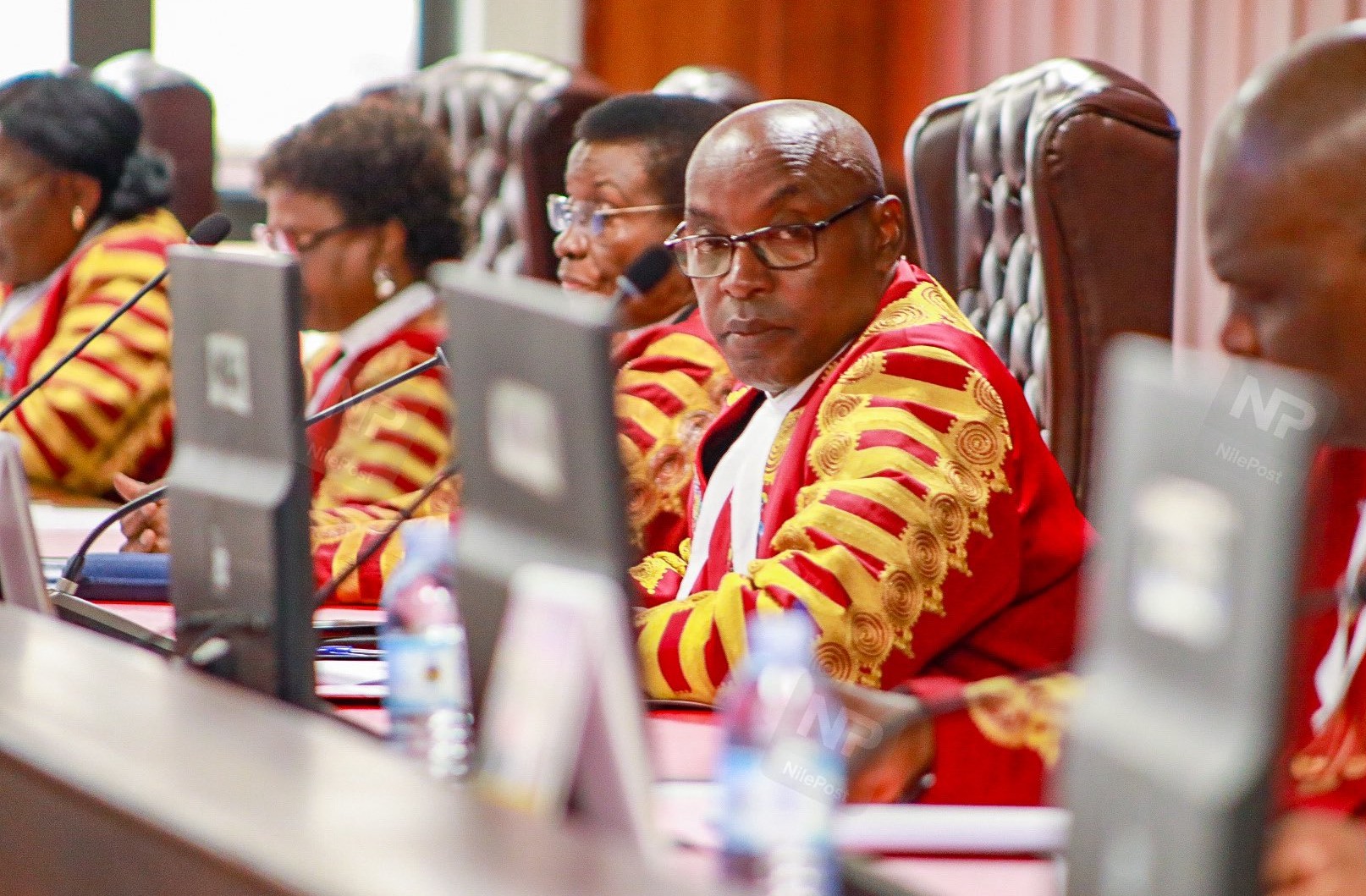
The Supreme Court of Uganda has allowed former presidential candidate Robert Kasibante to withdraw his petition challenging the outcome of the January 2026 presidential election, effectively confirming Yoweri Kaguta Museveni as the duly elected President of Uganda.
In a unanimous decision on the withdrawal itself, though divided on costs, the nine-justice panel led by Chief Justice Dr. Flavian Zeija granted Presidential Election Application No. 1 of 2026, allowing Kasibante to discontinue both his main petition and an accompanying application seeking extensive election-related disclosures.

Kasibante filed Presidential Election Petition No. 1 of 2026 on January 18, a day after the Electoral Commission of Uganda declared Museveni winner of the January 15 polls.
According to official results, Museveni secured 7,946,772 votes, more than 50 percent of the valid ballots cast, while other candidates trailed behind.
Kasibante garnered 33,440 votes. In his petition, Kasibante alleged widespread non-compliance with electoral laws, including voting in ungazetted polling stations, failure of the Biometric Voter Verification System, irregularities in the voters’ register, discrepancies between polling station tallies and transmitted results, and alleged partisan involvement of the army.
He sought nullification of Museveni’s election and requested a comprehensive audit of all presidential election returns, including backend data from the Electronic Results Transmission and Dissemination System, server logs, scanners, and biometric verification records.
A key component of the legal battle revolved around Kasibante’s application for discovery and inspection of both physical and electronic election materials.
He argued that backend server logs, audit trails, transmission timestamps, and error reports were essential to determine whether results had been manipulated.
The Electoral Commission opposed the request, citing national security risks, intellectual property concerns, and potential vulnerability to hacking.
The Attorney General also raised jurisdictional objections to the proposed forensic audit. When the discovery application came up for hearing, Kasibante sought an adjournment to amend it for greater specificity.
The Court rejected the request and reserved its ruling. However, on the eve of that ruling, Kasibante filed an application seeking to withdraw both the petition and the discovery application.
In affidavits supporting the withdrawal, Kasibante cited prohibitive financial costs. He stated that conducting a nationwide forensic audit of election materials across more than 50,000 polling stations would require highly specialized technical experts and sophisticated data analysis equipment.
The cumulative professional and logistical costs, he argued, were exponentially high and beyond his financial capacity.
He further disclosed that efforts to secure evidence and support from other former presidential candidates had failed. Without access to the requested digital evidence, he conceded, the petition could not be successfully sustained.
All three respondents—Museveni, the Electoral Commission, and the Attorney General—did not oppose the withdrawal itself but sought costs.
In a detailed ruling, the Supreme Court emphasized that while a petitioner has the right to seek withdrawal, leave of court is required under Section 63 of the Presidential Elections Act.
The justices held that refusing withdrawal would serve no meaningful purpose, given the petitioner’s admission that he lacked the evidence and financial resources to proceed.
The Court also underscored the gravity of presidential election petitions, noting that such cases affect national political stability and must be approached with full awareness of their logistical and financial implications.
Choice and consequences move together, the Court observed, stressing that candidates must carefully weigh the practical burdens of mounting a nationwide electoral challenge before filing.
With the petition withdrawn, the Court held that there is no longer any valid legal challenge to the election results.
Accordingly, under Section 61(4) of the Presidential Elections Act, Museveni is conclusively taken to have been duly elected President. While the withdrawal was unanimous, the Court was divided on costs.
The majority ruled that each party should bear its own costs, citing access to justice considerations and precedent from previous presidential petitions, including Kyagulanyi v Museveni & 2 Others.
The justices reasoned that imposing heavy financial penalties on petitioners could deter future election challenges, which are constitutionally permitted and serve public interest objectives. However, Justice Izama Madrama dissented on the issue of costs.
The Court noted that this was only the fifth presidential election petition filed since the promulgation of Uganda’s 1995 Constitution. It urged future candidates to benchmark from prior petitions and carefully evaluate the evidentiary and financial demands involved before instituting such proceedings. With the ruling delivered in Kampala, the 2026 presidential election now stands legally settled.






 English